Over the years, I've met several people who have said they're writing a book. I even looked into it once myself, before deciding that blogging is much easier. So when my friend, Bob Conrad, said he was writing a book I didn't think much of it. Those who know Bob better than I do probably weren't surprised when Bob not only finished writing it, but has now had it published.
The Good, The Bad, The Spin is an interesting look at the convergence of journalism, public relations, and on-line technology. Bob uses short, 1-2 page stories to illustrate the points he's making; many of which are first hand accounts of his own experiences. He also uses stories pulled from recent headlines.
One of the main points of the book is the importance of accuracy. Bob is of a scientific mind and he devotes one section of his book to scientific reason versus commonly held beliefs. I can't say I completely agree with him on the primacy of science. Scientists are human too, after all, but a little research goes a long way. The scientific approach is a good one for people working in PR, but there is still the problem of getting facts through the filter of journalists.
And that brings up a second major point of the book, the need for a greater amount of respect among the various types of communicators. Journalists and PR people tend to be wary of each other. A healthy skepticism is always, I believe, a good thing. Pride and turf wars seem to be more common among professional communicators. There are some good lessons here for us bloggers.
When I finished reading the book, I was a little mystified in that there is no formal conclusion, no over-arching theory of everything. After thinking about it, it makes sense that there isn't one. Technology changes rapidly and the state of communication is very much in flux. How this will develop over time is any one's guess. No matter who you are, or how you interact with the on-line world, this book is a good reminder that the ultimate goal of communication is the dissemination of truth.
Saturday, December 12, 2009
Sunday, December 6, 2009
Bernanke's thin line of defense
Senate hearings for the reconfirmation of Federal Reserve Chairman Ben Bernanke started this week. He is expected to be reconfirmed. Aside from a few Republican Senators, criticism seems to be light. Senator Jim De Mint of South Carolina almost identified the problem. In an exchange with Bernanke (see the video here), De Mint asks about the duties of the Fed. (The questions have been edited for the sake of brevity, the answers are in full).
De Mint: One of the goals is fostering the stability of the financial system in containing systemic risk. Has the Fed accomplished that goal?
Bernanke: No, be we have lots of other co-conspirators in that problem.
De Mint: Another is supervising and regulating the banking system to promote safety and soundness.
Bernanke: We've found some mistakes and we've tried to improve them.
De Mint: Another is conducting the nation's monetary policy in pursuit of the statutory objective of maximum employment.
Bernanke: We've moved monetary policy was much as possible to try to support employment growth, but obviously a 10% unemployment rate is not very satisfactory.
The problems are not so much with Bernanke as they are with the Federal Reserve Bank itself. Trying to manage, or even anticipate the thousands of individual economic decisions made every day by 300 million Americans is likely impossible. It should also be noted that government is very much a part of the system, and therefore plays a role in the systemic risk. All debt requires a buyer- a financier- someone who will take the risk of loaning money in return for the cash flow generated by the interest rate. With Congressional over-spending, the depreciating dollar, and interest rates as low as possible, foreign buyers of federal debt are becoming scarce. The risks outweigh the benefits.
Margaret Thatcher once said that "socialism works until you run out of rich people". It seems to me that the banks and the politicians have run out of consumers, and what we are witnessing is the end of the Consumer Society. Nowhere is it reported on the amount of loans that are rejected. I doubt that anyone even tracks that number. It was always assumed that people would want loans if they could get them. Why spend your own money when you can spend somebody else's. I suspect that assumption is no longer true.
One almost has to feel sorry for Ben Bernanke. Almost. Fed chairmen have always walked a thin line between the halls of power and the money centers. Produce just enough inflation to keep businesses hiring, debt accumulation payable, the bottom lines padded, and the people won't ask questions. Bernanke's misfortune is that after 95 years of Fed secrecy, the truth is coming out. Sharp downturns always unmask the frauds, and our government's monetary policy is one of them.
De Mint: One of the goals is fostering the stability of the financial system in containing systemic risk. Has the Fed accomplished that goal?
Bernanke: No, be we have lots of other co-conspirators in that problem.
De Mint: Another is supervising and regulating the banking system to promote safety and soundness.
Bernanke: We've found some mistakes and we've tried to improve them.
De Mint: Another is conducting the nation's monetary policy in pursuit of the statutory objective of maximum employment.
Bernanke: We've moved monetary policy was much as possible to try to support employment growth, but obviously a 10% unemployment rate is not very satisfactory.
The problems are not so much with Bernanke as they are with the Federal Reserve Bank itself. Trying to manage, or even anticipate the thousands of individual economic decisions made every day by 300 million Americans is likely impossible. It should also be noted that government is very much a part of the system, and therefore plays a role in the systemic risk. All debt requires a buyer- a financier- someone who will take the risk of loaning money in return for the cash flow generated by the interest rate. With Congressional over-spending, the depreciating dollar, and interest rates as low as possible, foreign buyers of federal debt are becoming scarce. The risks outweigh the benefits.
Margaret Thatcher once said that "socialism works until you run out of rich people". It seems to me that the banks and the politicians have run out of consumers, and what we are witnessing is the end of the Consumer Society. Nowhere is it reported on the amount of loans that are rejected. I doubt that anyone even tracks that number. It was always assumed that people would want loans if they could get them. Why spend your own money when you can spend somebody else's. I suspect that assumption is no longer true.
One almost has to feel sorry for Ben Bernanke. Almost. Fed chairmen have always walked a thin line between the halls of power and the money centers. Produce just enough inflation to keep businesses hiring, debt accumulation payable, the bottom lines padded, and the people won't ask questions. Bernanke's misfortune is that after 95 years of Fed secrecy, the truth is coming out. Sharp downturns always unmask the frauds, and our government's monetary policy is one of them.
Thursday, December 3, 2009
Book Review: The Return Of The Great Depression
Ordinarily, I bypass books with prophetic titles. In the case of The Return Of The Great Depression by Vox Day, I was willing to make an exception. I've been lurking on Vox's Blog for years, as well as reading his WND columns, and like most bloggers who have been around for years, he can be counted on to at least be thought provoking. Vox has an eclectic set of interests and his writings are where I was introduced to the Austrian school of economics.
Unlike the Keynesianism, which has made a comeback lately, and the Chicago school of monetarism, which has recently failed, the Austrians place subjectivity as the most important idea when trying to understand an economy. The battle between the scientific, or political economists as Vox calls them, and the philosophical economists, who emphasize logic rather than statistics, seems to me to be the main difference between them all. The Austrians and their offshoots are definitely in the philosophical camp.
As I've grown older, I have come to the realization that nobody really knows anything, so I wasn't too surprised when I got to Chapter 4 entitled, "No One Knows Anything." It is here where Vox's use of logic really shines. He dissects Gross Domestic Product (GDP), Gross National Product (GNP), and Unemployment numbers (U-3, U-6), and shows how subjective these statistics really are. They all begin with a set of assumptions about future events, then categorized by what the economist believes to be already true. Should any one assumption become untrue, or categorization turn out to be misplaced, the statistic will need to be revised. Since these statistics are revised all the time, this chapter should be required reading for anyone who has ever believed anything in the mainstream press.
For the more politically minded, anyone still wondering what all the fuss over Ron Paul was about last year, this book provides the answers. It includes the best argument from the right against Reagan era monetarism that I've ever read. Like Keynesianism, monetarism requires government intervention and top-down management of the economy. For those on the left, former Labor Secretary Robert Reich comes through looking fairly reasonable, while Paul Krugman's critique of Austrian theory is mercilessly dismembered point by point. There is also a nice section on the early development of Austrian theory, it being a response to the German scientific method that was being adopted by 20th Century fascists.
For myself, I tend to gravitate towards the philosophical rather than the scientific for the simple reason that it is easier to understand. That doesn't mean they're right. To his credit, Vox goes out of his way to explain the various ways he could be wrong. This book is an honest and multi-faceted look at our current situation. We may or may not suffer a full blown depression, but one thing is certain; debt can either be paid (deleveraged) or not paid (defaulted). In either case, we have a hard time ahead. Whether it is next year or next decade, at some point the music stops, the dance ends, and the band will want what is due.
Unlike the Keynesianism, which has made a comeback lately, and the Chicago school of monetarism, which has recently failed, the Austrians place subjectivity as the most important idea when trying to understand an economy. The battle between the scientific, or political economists as Vox calls them, and the philosophical economists, who emphasize logic rather than statistics, seems to me to be the main difference between them all. The Austrians and their offshoots are definitely in the philosophical camp.
As I've grown older, I have come to the realization that nobody really knows anything, so I wasn't too surprised when I got to Chapter 4 entitled, "No One Knows Anything." It is here where Vox's use of logic really shines. He dissects Gross Domestic Product (GDP), Gross National Product (GNP), and Unemployment numbers (U-3, U-6), and shows how subjective these statistics really are. They all begin with a set of assumptions about future events, then categorized by what the economist believes to be already true. Should any one assumption become untrue, or categorization turn out to be misplaced, the statistic will need to be revised. Since these statistics are revised all the time, this chapter should be required reading for anyone who has ever believed anything in the mainstream press.
For the more politically minded, anyone still wondering what all the fuss over Ron Paul was about last year, this book provides the answers. It includes the best argument from the right against Reagan era monetarism that I've ever read. Like Keynesianism, monetarism requires government intervention and top-down management of the economy. For those on the left, former Labor Secretary Robert Reich comes through looking fairly reasonable, while Paul Krugman's critique of Austrian theory is mercilessly dismembered point by point. There is also a nice section on the early development of Austrian theory, it being a response to the German scientific method that was being adopted by 20th Century fascists.
For myself, I tend to gravitate towards the philosophical rather than the scientific for the simple reason that it is easier to understand. That doesn't mean they're right. To his credit, Vox goes out of his way to explain the various ways he could be wrong. This book is an honest and multi-faceted look at our current situation. We may or may not suffer a full blown depression, but one thing is certain; debt can either be paid (deleveraged) or not paid (defaulted). In either case, we have a hard time ahead. Whether it is next year or next decade, at some point the music stops, the dance ends, and the band will want what is due.
Sunday, November 22, 2009
Book Review: Keynes, The Return Of The Master
It's good practice to pick up a book, from time to time, that you know you're going to disagree with. Knowing why you favor one idea over another requires knowing both. This was the reason why I read Keynes: The return of the master by Robert Skidelsky.
Having already written a three volume biography of Keynes, Skidelsky covers a lot of territory in 193 pages. In order to understand how Keynesianism might help us today, one must first understand Keynes the man, the times in which he lived, and his historical role. Skidelsky does an excellent job with the grand sweep of history and fleshing out Keynes the man. It is only when he is trying to explain today's muddled situation, with floating exchange rates and complex international savings/investment relationships that the book loses its rhythm.
Keynes was not just an economist. He was a philosopher whose main interest was economics. His moral philosophy was conventional, even Victorian by today's standards. He was an unapologetic capitalist who set out to solve what he saw as capitalism's biggest problem; unemployment. He lived at the dawn of modernity, the industrial revolution was in full swing, and the rise of communism and fascism were real threats to capitalist democracies. If a way could be found to maintain low unemployment, it would lead to a more harmonious world.
Among economists, both then and now, Keynes's greatest, and most controversial insight, was realizing the difference between risk and uncertainty. Risk is quantifiable. Risk can be managed using math and science. Our reasoning abilities can be used to predict the future with a fair degree of accuracy. But scientific risk management will only get us so far. Uncertainty is more like an enveloping fog, thick in some parts, thinner in others, always obscuring our expectations of what the future will bring. In a world of uncertainty, we make progress by trial and error, reverting to convention to get us through the mysterious shroud. When the most logical path is hidden and unknowable, scientific reason is of no practical benefit.
This does much to explain our present situation. Our computer models have failed us. Our reasoning abilities have become useless at predicting what is to come next, and so we revert to Keynes. He got us through this before, he can do it again.
There is a lot to like about Keynes. He seems to have been a kindly old gent, a revolutionary and independent thinker. Skidelsky points out that all the schools of economic thought have some amount of real world truth. The economics of capitalism is very much a work in progress. I still think my disagreements with Keynes are still valid, like a high savings rate represents a failure of growth, rather than an increase in real wealth, or that flooding the markets with depreciating cash will produce an overall good. Most of all, like all people of the political left, Keynes tends to assign greed, avarice, and self-interest only to the business class. The political class is assumed to be altruistic and working for the benefit of all. I have to think that if Keynes were alive today, he would be reconsidering that assumption.
I recommend this book for the general reader. Skidelsky writes in plain language and for the most part, treats his adversaries fairly. I would have liked it more if he had spent more time on the collapse of the Bretton-Woods Agreement and the resulting inflation, but maybe he'll have more to say about that in the next one.
Having already written a three volume biography of Keynes, Skidelsky covers a lot of territory in 193 pages. In order to understand how Keynesianism might help us today, one must first understand Keynes the man, the times in which he lived, and his historical role. Skidelsky does an excellent job with the grand sweep of history and fleshing out Keynes the man. It is only when he is trying to explain today's muddled situation, with floating exchange rates and complex international savings/investment relationships that the book loses its rhythm.
Keynes was not just an economist. He was a philosopher whose main interest was economics. His moral philosophy was conventional, even Victorian by today's standards. He was an unapologetic capitalist who set out to solve what he saw as capitalism's biggest problem; unemployment. He lived at the dawn of modernity, the industrial revolution was in full swing, and the rise of communism and fascism were real threats to capitalist democracies. If a way could be found to maintain low unemployment, it would lead to a more harmonious world.
Among economists, both then and now, Keynes's greatest, and most controversial insight, was realizing the difference between risk and uncertainty. Risk is quantifiable. Risk can be managed using math and science. Our reasoning abilities can be used to predict the future with a fair degree of accuracy. But scientific risk management will only get us so far. Uncertainty is more like an enveloping fog, thick in some parts, thinner in others, always obscuring our expectations of what the future will bring. In a world of uncertainty, we make progress by trial and error, reverting to convention to get us through the mysterious shroud. When the most logical path is hidden and unknowable, scientific reason is of no practical benefit.
This does much to explain our present situation. Our computer models have failed us. Our reasoning abilities have become useless at predicting what is to come next, and so we revert to Keynes. He got us through this before, he can do it again.
There is a lot to like about Keynes. He seems to have been a kindly old gent, a revolutionary and independent thinker. Skidelsky points out that all the schools of economic thought have some amount of real world truth. The economics of capitalism is very much a work in progress. I still think my disagreements with Keynes are still valid, like a high savings rate represents a failure of growth, rather than an increase in real wealth, or that flooding the markets with depreciating cash will produce an overall good. Most of all, like all people of the political left, Keynes tends to assign greed, avarice, and self-interest only to the business class. The political class is assumed to be altruistic and working for the benefit of all. I have to think that if Keynes were alive today, he would be reconsidering that assumption.
I recommend this book for the general reader. Skidelsky writes in plain language and for the most part, treats his adversaries fairly. I would have liked it more if he had spent more time on the collapse of the Bretton-Woods Agreement and the resulting inflation, but maybe he'll have more to say about that in the next one.
Sunday, November 15, 2009
The Currencies Of Last Resort
As one of my favorite bloggers, Sybil's Star often says, "you can take the gold out of the standard, but you can't take the standard out of the gold." A case in point was the 1970's.
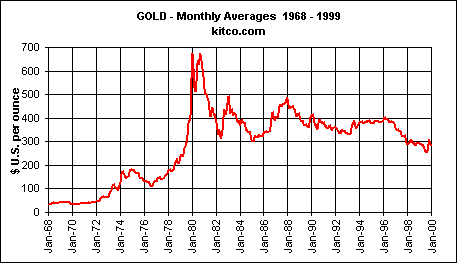
In 1971, President Nixon took the U.S., and the rest of the world, off the gold standard. Gold prices went up, as expected, but soon began to settle. The OPEC oil embargo of 1973 caused another bump, but again gold prices soon began to settle. Then, inflation kicked-in, and the gold market has been a roller coaster ride ever since.
Flying under the radar, silver (the poor man's gold) is even more instructive. Inflation causes more uncertainty about the future than even warfare.

The first little bump is war with England (1812-15), the second is the Civil War (1860-65). World Wat I (1914-18) caused a minor ripple, while the depression and World War II were non-events, as far as silver was concerned. Then there is the inflation of the 1970's.
But why is this so? Everyone knows that gold has no intrinsic value, and silver has very little. As is often argued, the metals have no more real value than the circular rock money used by the people on the Pacific island of Yap.
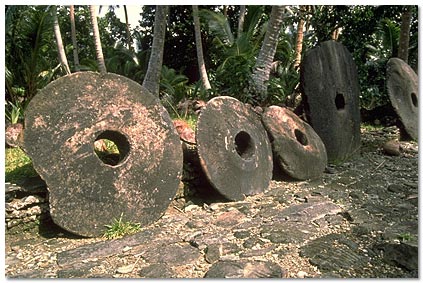
Gold and silver are only rocks too. It is the value we place on them that determines their worth. Given the resources we have, there is nothing else to use.
In a recent interview, President Obama said:
“A lot of independents, Democrats and Republicans -- all are concerned about is what are we going to do about this long-term debt,” Obama told ABC’s Jake Tapper Monday. “We've got to show people that we are responsible stewards for their taxpayer dollars and that we're taking some serious steps to at least lay the foundation -- the pathway -- for bringing those deficits down over the next several years.”
An unnamed White House official followed up; “Democrats have to reassure voters we are not being reckless.” Here's why.


Inflation is coming. Got rocks?
In 1971, President Nixon took the U.S., and the rest of the world, off the gold standard. Gold prices went up, as expected, but soon began to settle. The OPEC oil embargo of 1973 caused another bump, but again gold prices soon began to settle. Then, inflation kicked-in, and the gold market has been a roller coaster ride ever since.
Flying under the radar, silver (the poor man's gold) is even more instructive. Inflation causes more uncertainty about the future than even warfare.
The first little bump is war with England (1812-15), the second is the Civil War (1860-65). World Wat I (1914-18) caused a minor ripple, while the depression and World War II were non-events, as far as silver was concerned. Then there is the inflation of the 1970's.
But why is this so? Everyone knows that gold has no intrinsic value, and silver has very little. As is often argued, the metals have no more real value than the circular rock money used by the people on the Pacific island of Yap.
Gold and silver are only rocks too. It is the value we place on them that determines their worth. Given the resources we have, there is nothing else to use.
In a recent interview, President Obama said:
“A lot of independents, Democrats and Republicans -- all are concerned about is what are we going to do about this long-term debt,” Obama told ABC’s Jake Tapper Monday. “We've got to show people that we are responsible stewards for their taxpayer dollars and that we're taking some serious steps to at least lay the foundation -- the pathway -- for bringing those deficits down over the next several years.”
An unnamed White House official followed up; “Democrats have to reassure voters we are not being reckless.” Here's why.
Inflation is coming. Got rocks?
Sunday, November 8, 2009
Twitter In The Over 50 Club
A buddy of mine at work, who is roughly the the same age as me (55), informed me one day that he had been "talked into signing up with Facebook." He then went on to describe how stupid and pointless it is. I asked him about Twitter;
"Oh hell no", he said. "I can see where teenagers would like it. They can talk on the phone for 3 hours about nothing. But what am I going to tell everybody, that I cut my toenails today? Who gives a shit!"
I have to admit, I'm somewhat sympathetic to this view. I signed up with this stuff last March, and although I've found it interesting in a sociological kind of way, I haven't been able to make much use of it. As the conversation with my friend went on, I told him that I had followed on endurance auto race from Japan, courtesy of Drayson Racing. It triggered some long forgotten memories.
 DraysonRacing Good morning from Okayama. We are approx. an hour from the start of Asian Le Mans Series Race 2. Jonny will again start from the pole.4:03 PM Oct 31st from TweetDeck
DraysonRacing The car has now taken its place at the point of the grid. We are approx. 20 mins from the green flag. 3 hours,/136 laps will be run today.4:41 PM Oct 31st from TweetDeck
In the early '60's, Major League Baseball was almost always played during the day. Most stadiums didn't have lights yet, and even for those that did, night games were a novelty. For a school aged kid, this presented a problem until the invention of the pocket sized transistor radio. Whether a jock or a nerd, cool guy or dweeb, on certain days in October, the kid with the transistor radio was the most popular kid in school.
DraysonRacing GREEN FLAG!4:58 PM Oct 31st from TweetDeck
During recess, we'd follow that poor kid around the playground like a pack of dogs waiting for their bowls. At lunchtime, you would have seen us all out on the grass, Indian Council style, in a circle, cross-legged, in silence, staring at the tiny magic box.
DraysonRacing Give & take of traffic has us back 14 secs to the leader; ahead of 3rd by 2.5 secs. All-told, the gaps remain close; 2 hrs, 14 min to go.5:44 PM Oct 31st from TweetDeck
As time went on, they came out with a little ear piece that connected to the radio with a wire. That meant that if a kid was sufficiently discreet, he could listen in class. Updates could be whispered. or notes could be passed, and we could all stay informed. One time I remember, the teacher was writing on the blackboard with her back turned to the class when a kid near the front and off to the side held up his binder with the message:
Yanks
3-2
5th
and that's when it clicked. Waiting for the Twitter updates had turned me into a 10 year old again.
DraysonRacing Drayson Stop 2 - Lap 87, 55 mins remaining - Shell Fuel, Michelin Tyres and a Driver Change. Jonny IN, Paul Out. Running P3. Great stop!7:04 PM Oct 31st from TweetDeck
Of course, the kid would eventually get caught. No worries, another would have one and the updates would continue. As the saying goes, history doesn't repeat itself, it rhymes.
DraysonRacing 15 mins remaining and Jonny is 10 seconds behind the Audi in P4.7:43 PM Oct 31st from TweetDeck
On March 20, the regular race season opens with the 12 hours of Sebring. I don't know if other teams are doing this yet. Multiple Twitter updates could be as good a way to "watch" the race as any.
DraysonRacing 6 minutes and 2 seconds remain. Jonny calls in to confirm the Audi within his sight is for position. It definitely is!7:52 PM Oct 31st from TweetDeck
DraysonRacing 1.5 seconds, 4 minuts remaining between Drayson and P47:53 PM Oct 31st from TweetDeck
DraysonRacing Jonny flashes by just off the rear of the Audi... 0.475 seconds!7:54 PM Oct 31st from TweetDeck
In any case, I've found another use for Twitter. It took a long time, but it was just a matter of staying with it. Sooner or later, the Law of Unintended Consequences kicks in.
DraysonRacing Jonny takes P4. White flag lap!!!7:57 PM Oct 31st from TweetDeck
DraysonRacing Team ends 2009 'World Tour' on high note! P4!!! Highest Privateer Finisher! Fastest race lap, again, by Jonny.8:01 PM Oct 31st from TweetDeck
That's all for today. It's time to cut my toenails.
"Oh hell no", he said. "I can see where teenagers would like it. They can talk on the phone for 3 hours about nothing. But what am I going to tell everybody, that I cut my toenails today? Who gives a shit!"
I have to admit, I'm somewhat sympathetic to this view. I signed up with this stuff last March, and although I've found it interesting in a sociological kind of way, I haven't been able to make much use of it. As the conversation with my friend went on, I told him that I had followed on endurance auto race from Japan, courtesy of Drayson Racing. It triggered some long forgotten memories.
 DraysonRacing Good morning from Okayama. We are approx. an hour from the start of Asian Le Mans Series Race 2. Jonny will again start from the pole.4:03 PM Oct 31st from TweetDeck DraysonRacing The car has now taken its place at the point of the grid. We are approx. 20 mins from the green flag. 3 hours,/136 laps will be run today.4:41 PM Oct 31st from TweetDeck
In the early '60's, Major League Baseball was almost always played during the day. Most stadiums didn't have lights yet, and even for those that did, night games were a novelty. For a school aged kid, this presented a problem until the invention of the pocket sized transistor radio. Whether a jock or a nerd, cool guy or dweeb, on certain days in October, the kid with the transistor radio was the most popular kid in school.
DraysonRacing GREEN FLAG!4:58 PM Oct 31st from TweetDeckDuring recess, we'd follow that poor kid around the playground like a pack of dogs waiting for their bowls. At lunchtime, you would have seen us all out on the grass, Indian Council style, in a circle, cross-legged, in silence, staring at the tiny magic box.
DraysonRacing Give & take of traffic has us back 14 secs to the leader; ahead of 3rd by 2.5 secs. All-told, the gaps remain close; 2 hrs, 14 min to go.5:44 PM Oct 31st from TweetDeckAs time went on, they came out with a little ear piece that connected to the radio with a wire. That meant that if a kid was sufficiently discreet, he could listen in class. Updates could be whispered. or notes could be passed, and we could all stay informed. One time I remember, the teacher was writing on the blackboard with her back turned to the class when a kid near the front and off to the side held up his binder with the message:
Yanks
3-2
5th
and that's when it clicked. Waiting for the Twitter updates had turned me into a 10 year old again.
DraysonRacing Drayson Stop 2 - Lap 87, 55 mins remaining - Shell Fuel, Michelin Tyres and a Driver Change. Jonny IN, Paul Out. Running P3. Great stop!7:04 PM Oct 31st from TweetDeckOf course, the kid would eventually get caught. No worries, another would have one and the updates would continue. As the saying goes, history doesn't repeat itself, it rhymes.
DraysonRacing 15 mins remaining and Jonny is 10 seconds behind the Audi in P4.7:43 PM Oct 31st from TweetDeckOn March 20, the regular race season opens with the 12 hours of Sebring. I don't know if other teams are doing this yet. Multiple Twitter updates could be as good a way to "watch" the race as any.
DraysonRacing 6 minutes and 2 seconds remain. Jonny calls in to confirm the Audi within his sight is for position. It definitely is!7:52 PM Oct 31st from TweetDeck DraysonRacing 1.5 seconds, 4 minuts remaining between Drayson and P47:53 PM Oct 31st from TweetDeck DraysonRacing Jonny flashes by just off the rear of the Audi... 0.475 seconds!7:54 PM Oct 31st from TweetDeckIn any case, I've found another use for Twitter. It took a long time, but it was just a matter of staying with it. Sooner or later, the Law of Unintended Consequences kicks in.
DraysonRacing Jonny takes P4. White flag lap!!!7:57 PM Oct 31st from TweetDeck DraysonRacing Team ends 2009 'World Tour' on high note! P4!!! Highest Privateer Finisher! Fastest race lap, again, by Jonny.8:01 PM Oct 31st from TweetDeckThat's all for today. It's time to cut my toenails.
Wednesday, November 4, 2009
More From The Transparency Wars
In a clear case of the Empire striking back, Mel Watt, a Democrat from North Carolina, who chairs the domestic monetary policy and technology subcommittee of the House Financial Services Committee has "gutted" H.R. 1207, the bill to audit the Federal Reserve. Some possible motivations for Mr. Watt's actions come from American Banking News.
Bloomberg reports on the key provisions taken out of the bill:
Ron Paul, the author of H.R. 1207, plans to offer an amendment when the new bill reaches the floor. Barney Frank, the Chairman of the Financial Services Committee said the legislation will likely be rolled into the broader financial regulation package, currently still in progress.
And speaking of Bloomberg, the story of they're lawsuit, filed under the Freedom of Information Act against the Federal Reserve Bank of New York, seems to have disappeard. When last heard from, the government had 30 days to appeal. Those 30 days were up in early October, but there's been no news on the outcome. My only guess is that there must be some back room negotiations taking place.
One thing for certain in all this; finding out what the government is doing with our money is not going to be easy.
Bank of America (NYSE:BAC) has its headquarters in his congressional district, which is based in Charlotte...Watt’s largest contributors included American Express (NYSE: AXP), Wachovia, Bank of America and the American Bankers Association. Altogether the financial industry donated over $217,109 to Watt, which was over 35 percent of the overall contributions he received.
Bloomberg reports on the key provisions taken out of the bill:
The bill, with 308 co-sponsors, has been stripped of provisions that would remove Fed exemptions from audits of transactions with foreign central banks, monetary policy deliberations, transactions made under the direction of the Federal Open Market Committee and communications between the Board, the reserve banks and staff
Ron Paul, the author of H.R. 1207, plans to offer an amendment when the new bill reaches the floor. Barney Frank, the Chairman of the Financial Services Committee said the legislation will likely be rolled into the broader financial regulation package, currently still in progress.
And speaking of Bloomberg, the story of they're lawsuit, filed under the Freedom of Information Act against the Federal Reserve Bank of New York, seems to have disappeard. When last heard from, the government had 30 days to appeal. Those 30 days were up in early October, but there's been no news on the outcome. My only guess is that there must be some back room negotiations taking place.
One thing for certain in all this; finding out what the government is doing with our money is not going to be easy.
Sunday, November 1, 2009
A Presidential Clunker?
Edmunds car guides have been around since 1966. In 2006 they ceased paper publication and went all online as edmunds.com. They have become a "must use" site for anyone buying a new or used car. So when they came out with a report that the governments Cash for Clunkers (CARS) program cost the taxpayers $24,000 per vehicle, it raised a few eyebrows, including some within the White House.
At issue is this; How many cars would have been sold without the subsidy? The president's Council of Economic Advisers says 700,000 based on total sales. Edmunds estimated it to be 125,000 using standard and widely accepted methodology as Francis Cianfrocca reports in New Ledger:
What would have happened had we done something different is a problem economists face all the time. Digging through historical data and finding trends is a daily occurrence. The interesting point here is that the auto industry seems to be improving without government help. We'll know more over the next few months; if sales plummet below historical trends, then the subsidy helped; if trends continue, then no subsidy was necessary.
This is why economics is such a good way to find out what is really going on. The party in power always has an interest in showing that they are doing the right thing. It is the duty of the opposition to present alternatives. Through it all, the unheralded economist searches for the truth. To the extent the economists remain apolitical, they can be trusted.
At issue is this; How many cars would have been sold without the subsidy? The president's Council of Economic Advisers says 700,000 based on total sales. Edmunds estimated it to be 125,000 using standard and widely accepted methodology as Francis Cianfrocca reports in New Ledger:
The analysis was based on an examination of parallel sales trends of vehicles (like luxury cars) that were NOT eligible for a CARS subsidy. These trends showed a steady improvement in overall vehicle sales over the subsidy period. Edmunds assumed the historical sales ratios between luxury cars and non-luxury models, and they compared them to the actual sales increase observed for the CARS-eligible categories. That gave them an above-trend increase of about 125,000 units.
What would have happened had we done something different is a problem economists face all the time. Digging through historical data and finding trends is a daily occurrence. The interesting point here is that the auto industry seems to be improving without government help. We'll know more over the next few months; if sales plummet below historical trends, then the subsidy helped; if trends continue, then no subsidy was necessary.
This is why economics is such a good way to find out what is really going on. The party in power always has an interest in showing that they are doing the right thing. It is the duty of the opposition to present alternatives. Through it all, the unheralded economist searches for the truth. To the extent the economists remain apolitical, they can be trusted.
Sunday, October 25, 2009
Globalization's Downward Spiral
In 6,000 years of recorded human history there has never been a country, or an empire, that grew strong with a weak monetary system. The fall of empires is always foreshadowed by devaluation; Always. From Byzantines byzant, to Rome's drachma, to England's pound, the deliberate cheapening of the money marks the beginning of the end.
I think of this when I read in the financial press about how the falling dollar is good for exports, a fact that is technically true. They say higher exports will lead to recovery because of the global market. Countries are in a race to out-export each other, and we have to compete. Meanwhile, the working poor and lower middle class see the price of bread and shoes rise, and wonder why.
To his credit, Donald Luskin at least mentions the working poor, if only in passing.
The fact is that with a sinking dollar everybody loses, the Walmart shoppers are only the first in line. This isn't just a screed for the bleeding heart liberals either. The ability of the working poor to acquire necessities is the foundation on which all else is built. When the poor go without, the middle class lose their jobs, and then who's shopping at Walmart?
And there's no safe haven in the booming stock market either. As Luskin himself points out:
But it's not a sign of recovery as Luskin concludes. Like gamblers who only talk of their winnings, the bulls on Wall Street never mention the 15% haircut. For them, the rise pads the bottom line, and the government gets to claim credit for improving conditions. Statistics are about quantity, not quality.
On our current trajectory, the dollar will hit an historic low sometime around Christmas. My guess is, they'll blame the lack of retail sales on consumers.
I think of this when I read in the financial press about how the falling dollar is good for exports, a fact that is technically true. They say higher exports will lead to recovery because of the global market. Countries are in a race to out-export each other, and we have to compete. Meanwhile, the working poor and lower middle class see the price of bread and shoes rise, and wonder why.
To his credit, Donald Luskin at least mentions the working poor, if only in passing.
It doesn’t take a genius to figure out the winners and losers on this score. If you buy cheap Chinese-made goods at Walmart, you’re going to be a loser. Prices are going up.
The fact is that with a sinking dollar everybody loses, the Walmart shoppers are only the first in line. This isn't just a screed for the bleeding heart liberals either. The ability of the working poor to acquire necessities is the foundation on which all else is built. When the poor go without, the middle class lose their jobs, and then who's shopping at Walmart?
And there's no safe haven in the booming stock market either. As Luskin himself points out:
This year’s 15 percent dollar drop began on March 9, the very day the stock market found its bottom. Tick for tick, the dollar’s decline has tracked the stock market’s monster rally.
But it's not a sign of recovery as Luskin concludes. Like gamblers who only talk of their winnings, the bulls on Wall Street never mention the 15% haircut. For them, the rise pads the bottom line, and the government gets to claim credit for improving conditions. Statistics are about quantity, not quality.
On our current trajectory, the dollar will hit an historic low sometime around Christmas. My guess is, they'll blame the lack of retail sales on consumers.
Tuesday, October 20, 2009
Development In The Public Eye
Another October, time for me and my brother Steve to make our annual pilgrimage to Laguna Seca Raceway for the American Le Mans Series
(ALMS) 4 hour endurance race in Monterrey, California. The series usually features 4 classes of cars, 2 prototype (experimental) and 2 production (street cars). Recently they added a 5Th, the Michelin Green X Challenge.
All of the Green X cars run on bio fuel and are the most experimental of the prototypes. The one that I was most impressed with was the Dyson Lola/Mazda turbo-diesel hybrid.

Dyson Racing started as a father/son team over 25 years ago and has been a major independent in the ALMS since 1999. The father is now retired. They run 2 cars but the white and green #16 caught my eye at the 2 hour mark, when we were sitting in turn 4. He was going nose to tail with eventual winner Gil De Ferran in his more powerful Jim Hall Acura. De Ferran should have been losing him in the straights, but wasn't. At about 2 1/2 hours into the race, the Dyson team had a lengthy pit stop which put them out of the top ten.
We arrived early, in time for the morning warm-ups and spent some time wandering around in the pits. I didn't shoot a lot of video as I wanted to save the battery for the race. One shot I couldn't pass up was a close-up of De Ferran checking the seating arrangements in his Acura. Another shot was an exhibit of vintage Jim Hall Chevy Chaparrals from the old Can-Am series. There were a lot of exhibits explaining some of the new technologies, and of course, the inevitable t-shirt booths and $3 hot dogs too.
Shooting video of auto racing is not easy. I was battling fences all day long. There were some holes in the fence to shoot through, but these were always crowded with photographers. The hilly terrain sometimes helped. One guy I saw was carrying a small aluminum step stool and shooting over the fence. Great idea, I'll have to remember that for next time.
We watched the start of the race at turn 2, the fastest part of the track. After about an hour we moved to turn 6, then to turn 4. We stopped by turn 10 on our way to the "corkscrew", a series of corners starting with a 90 degree left hander, then a 90 degree right hander and a sweeping left hander all happening in a 3 story drop in elevation. We finished up back at turn 2. It was a great day, and a great race.
(ALMS) 4 hour endurance race in Monterrey, California. The series usually features 4 classes of cars, 2 prototype (experimental) and 2 production (street cars). Recently they added a 5Th, the Michelin Green X Challenge.
All of the Green X cars run on bio fuel and are the most experimental of the prototypes. The one that I was most impressed with was the Dyson Lola/Mazda turbo-diesel hybrid.
Dyson Racing started as a father/son team over 25 years ago and has been a major independent in the ALMS since 1999. The father is now retired. They run 2 cars but the white and green #16 caught my eye at the 2 hour mark, when we were sitting in turn 4. He was going nose to tail with eventual winner Gil De Ferran in his more powerful Jim Hall Acura. De Ferran should have been losing him in the straights, but wasn't. At about 2 1/2 hours into the race, the Dyson team had a lengthy pit stop which put them out of the top ten.
We arrived early, in time for the morning warm-ups and spent some time wandering around in the pits. I didn't shoot a lot of video as I wanted to save the battery for the race. One shot I couldn't pass up was a close-up of De Ferran checking the seating arrangements in his Acura. Another shot was an exhibit of vintage Jim Hall Chevy Chaparrals from the old Can-Am series. There were a lot of exhibits explaining some of the new technologies, and of course, the inevitable t-shirt booths and $3 hot dogs too.
Shooting video of auto racing is not easy. I was battling fences all day long. There were some holes in the fence to shoot through, but these were always crowded with photographers. The hilly terrain sometimes helped. One guy I saw was carrying a small aluminum step stool and shooting over the fence. Great idea, I'll have to remember that for next time.
We watched the start of the race at turn 2, the fastest part of the track. After about an hour we moved to turn 6, then to turn 4. We stopped by turn 10 on our way to the "corkscrew", a series of corners starting with a 90 degree left hander, then a 90 degree right hander and a sweeping left hander all happening in a 3 story drop in elevation. We finished up back at turn 2. It was a great day, and a great race.
Saturday, October 17, 2009
The Common Knowledge Pool
Dr. Elinor Ostrom became the first woman to win the Nobel Prize in Economics this week. Her selection was somewhat controversial, not because she's a woman, but because her nearly 60 years of field work and research challenge the left/right political and economic establishments. Her work centers around the Common Pool Resource, a condition where a resource is neither regulated by government nor privately owned, and seems to refute some long held assumptions. The implications of her research are widespread and far-reaching, and include the future of the internet. To understand how, let's first travel back to Merry Old England.
Before there was such a thing as economics, the Lords of England allowed the peasants a certain amount of grassland on which to feed their livestock. Not wanting to sully themselves with petty squabbles, the Lords left the management of the commons to the peasants. Self-interest soon took over in the form of overgrazing, and what had been a growing prosperity turned into poverty. This “Tragedy of the Commons” has been accepted wisdom for both Adam Smith's theories on the free market and Thomas Hobbes's regulatory Leviathan. The argument between privatization and regulation assumes the tragedy as a given.
As a student at UCLA in the mid 1950's, Elinor Ostrom became involved in California's water wars. The rising population after World War II was causing a decrease in the water table in the Los Angeles basin. Seawater from the nearby Pacific Ocean was contaminating the city's drinking water. Her interest was not so much in one solution or another, but in how the disparate groups of people came together and organized themselves to find a solution. This led to a lifetime of study in the common pool resource.
Together with her husband, she co-founded the Workshop in Political Theory and Policy Analysis at Indiana University, an inter-disciplinary group to research some basic questions. Do we need a central authority to manage resources? Is tragedy the necessary outcome of the commons? From forests and fishing grounds, to inner cities Dr. Olstrom’s group has found that with communication among participants and self policing, common pool resources can reach efficiency levels equal or better (92%) than either government regulated or privately owned resources.
In today’s technological world, one common field is the internet and knowledge is the common resource. Knowledge can be privately owned in the form of subscription services and regulation is a constant threat. Part of what Dr. Ostrom’s work shows is that it is not enough to simply use the internet. Active participation is key to keeping the internet free. Self policing, calling out abusers, is also important. As Thomas Jefferson said, an informed citizenry is fundamental to a free people. There’s a lot at stake here and the choices are ours. The ideas of Elinor Ostrom are a big deal for us commoners and her Nobel Prize is well deserved.
Articles written by two of her former students can be found here and here. Her press conference can be found here. It runs 23 minutes.
Before there was such a thing as economics, the Lords of England allowed the peasants a certain amount of grassland on which to feed their livestock. Not wanting to sully themselves with petty squabbles, the Lords left the management of the commons to the peasants. Self-interest soon took over in the form of overgrazing, and what had been a growing prosperity turned into poverty. This “Tragedy of the Commons” has been accepted wisdom for both Adam Smith's theories on the free market and Thomas Hobbes's regulatory Leviathan. The argument between privatization and regulation assumes the tragedy as a given.
As a student at UCLA in the mid 1950's, Elinor Ostrom became involved in California's water wars. The rising population after World War II was causing a decrease in the water table in the Los Angeles basin. Seawater from the nearby Pacific Ocean was contaminating the city's drinking water. Her interest was not so much in one solution or another, but in how the disparate groups of people came together and organized themselves to find a solution. This led to a lifetime of study in the common pool resource.
Together with her husband, she co-founded the Workshop in Political Theory and Policy Analysis at Indiana University, an inter-disciplinary group to research some basic questions. Do we need a central authority to manage resources? Is tragedy the necessary outcome of the commons? From forests and fishing grounds, to inner cities Dr. Olstrom’s group has found that with communication among participants and self policing, common pool resources can reach efficiency levels equal or better (92%) than either government regulated or privately owned resources.
In today’s technological world, one common field is the internet and knowledge is the common resource. Knowledge can be privately owned in the form of subscription services and regulation is a constant threat. Part of what Dr. Ostrom’s work shows is that it is not enough to simply use the internet. Active participation is key to keeping the internet free. Self policing, calling out abusers, is also important. As Thomas Jefferson said, an informed citizenry is fundamental to a free people. There’s a lot at stake here and the choices are ours. The ideas of Elinor Ostrom are a big deal for us commoners and her Nobel Prize is well deserved.
Articles written by two of her former students can be found here and here. Her press conference can be found here. It runs 23 minutes.
Tuesday, October 13, 2009
Traditional Media Win The So-What Prize
Now that the who-haw over President Obama's winning of the Nobel Peace Prize is subsiding, was the story really that big of a deal? Is it so big that the traditional media needs to spend the better part of a week on it? It seems everyone is trying to find some greater meaning from a mostly meaningless prize. Was this really news, or a manifestation of the herd mentality? OK, so he hasn't really done anything to deserve it. So what? It's their prize, they can give it to anyone they want to, and for any reason.
Meanwhile over in the blogosphere, Zero Hedge has been doing some excellent investigative reporting on the near criminal enterprise that Goldman Sachs has become, not just robbing the small investor with their HFT computer system, but mutual fund managers as well. Rob Kirby at Financial Sense has been reporting on the downright bizarre happenings in the precious metals and Treasury Bill markets, and then there's this; Dr. Carsten Mundt of Kangaroo Tail charts the S&P 500. In a normal market, the P/E Ratio should top out at about 20.
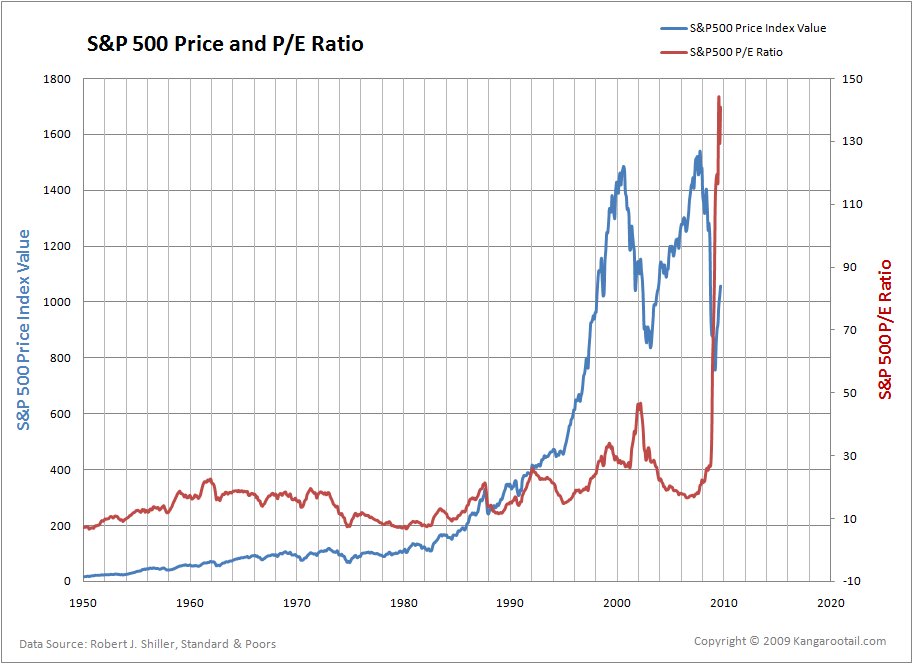
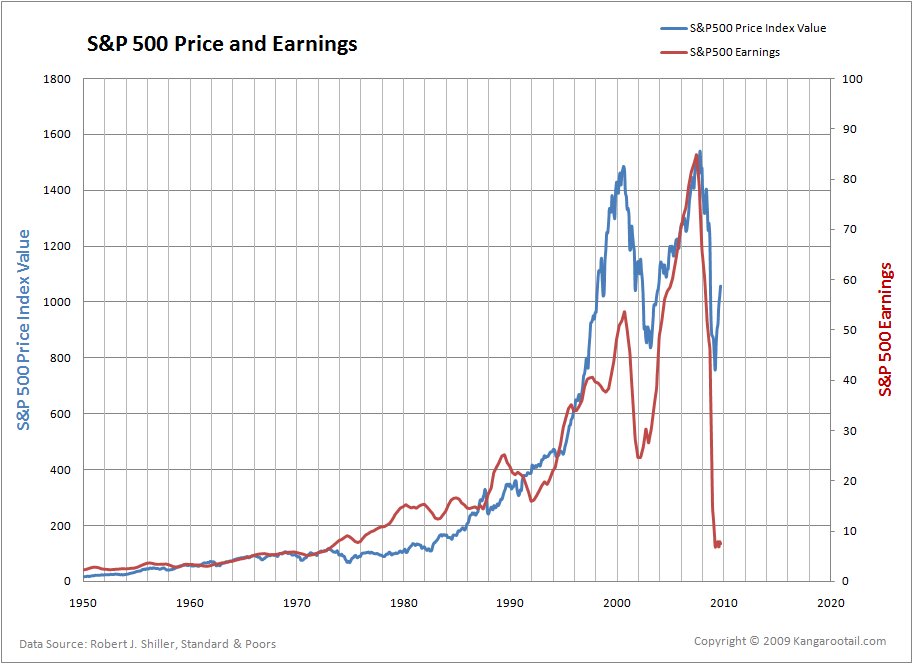
Compare the solid prosperity of the 1950's with where we are today. Compare the Reagan boom years of the 1980's, the so-called "Decade of Greed", with where we are today. Does it look like everything is going to be fine, or would you say that something has gone terribly wrong? This booming market has nothing to do with company profits. In the next chart, the red line shows the earnings of the 500 companies.
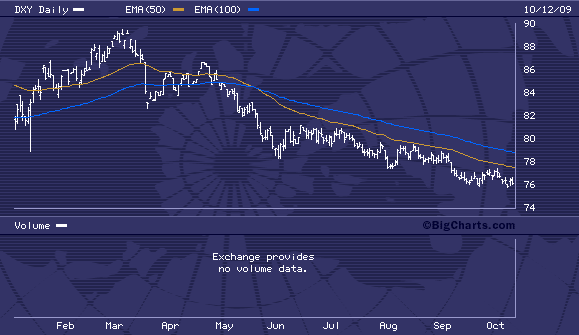
As a final point, in case you might think these things don't affect you, here's what the value of the money in your wallet has been doing since the beginning of the year. Note that the fall in the dollar started in March, the same month that the "recovery" supposedly began.
It wasn't so long ago that the traditional media was full of stories about bankrupt newspapers and plunging TV ratings. It's a subject they'll no doubt be returning to in the future.
Meanwhile over in the blogosphere, Zero Hedge has been doing some excellent investigative reporting on the near criminal enterprise that Goldman Sachs has become, not just robbing the small investor with their HFT computer system, but mutual fund managers as well. Rob Kirby at Financial Sense has been reporting on the downright bizarre happenings in the precious metals and Treasury Bill markets, and then there's this; Dr. Carsten Mundt of Kangaroo Tail charts the S&P 500. In a normal market, the P/E Ratio should top out at about 20.
Compare the solid prosperity of the 1950's with where we are today. Compare the Reagan boom years of the 1980's, the so-called "Decade of Greed", with where we are today. Does it look like everything is going to be fine, or would you say that something has gone terribly wrong? This booming market has nothing to do with company profits. In the next chart, the red line shows the earnings of the 500 companies.
As a final point, in case you might think these things don't affect you, here's what the value of the money in your wallet has been doing since the beginning of the year. Note that the fall in the dollar started in March, the same month that the "recovery" supposedly began.
It wasn't so long ago that the traditional media was full of stories about bankrupt newspapers and plunging TV ratings. It's a subject they'll no doubt be returning to in the future.
Tuesday, October 6, 2009
The Economic Workshop At UNR (Part 2 of 2)
The REAP and BEA websites offer a wealth of regional information and both encourage republication of their data, tables and charts.
The Regional Economic Analysis Project (REAP) is the brainchild of retired professor Gary Smith of Washington State University. Along with the charts and tables, REAP includes analysis on what things mean, and just as important, what they don’t mean. Just poking around on it, I found several cautionary tales of other numbers to check before reaching a conclusion. Being the work of a former professor, REAP is as much a teaching tool as a source of information. The site is arranged by state, county, and regions (groups of counties).
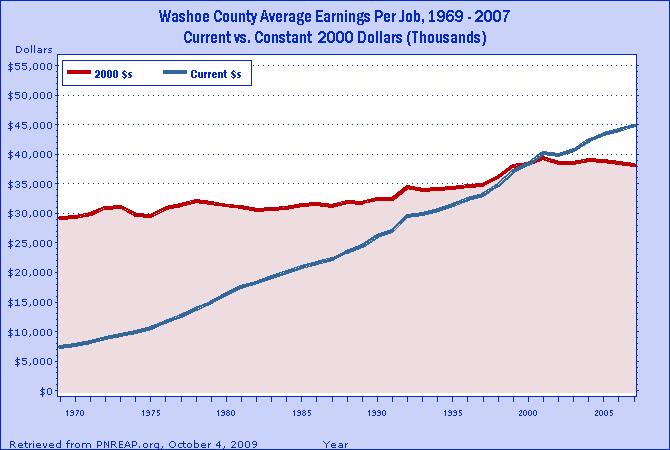
From the main page, click on Nevada. This brings you to a drop down menu of economic categories, and after choosing one, you get a list on the right of counties and regions. Here's the per capita income of Washoe County. It has the added bonus of showing inflation. The blue line shows actual dollars while the red line shows inflation adjusted dollars (buying power).
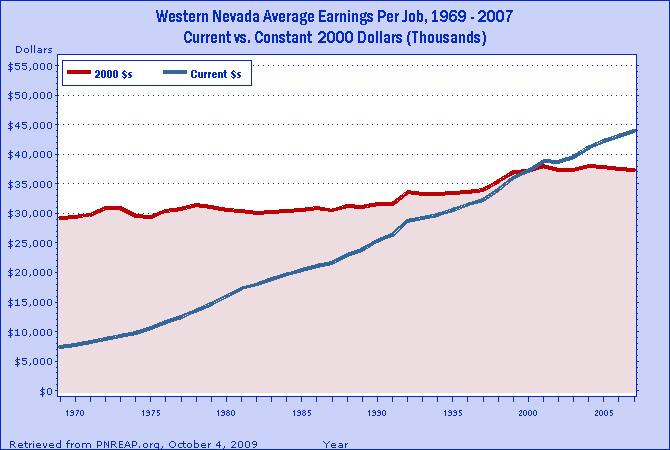
Here's our region showing Washoe, Carson, Story, and Douglas Counties. The numbers are slightly different, but the trends are the same.
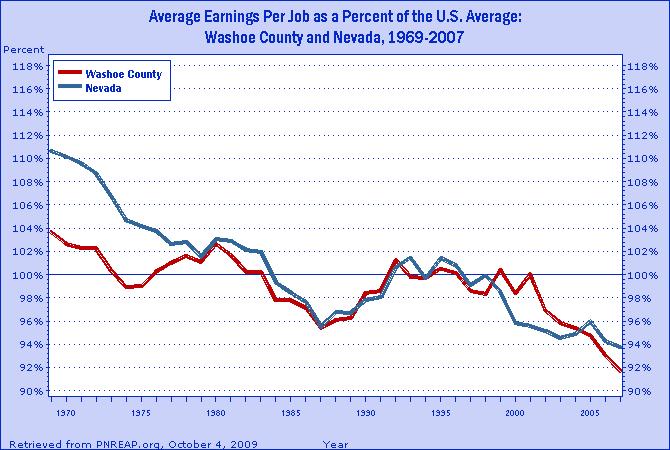
This chart shows the earnings per job in Washoe County and Nevada. 100% is the national average and is used as the baseline. This chart comes with a cautionary tale. Since it measures both full and part-time employment, sometimes a rise in part-time jobs can cause a decrease in the overall average. One would have to look through the employment numbers before reaching a conclusion.
There are ways to combine the charts and tables, but I'm still just poking around here. Did I mention I take lousy notes? Luckily, there are instructions, and Dr. Smith is happy to help.
Alison Adam heads up the Bureau of Economic Analysis website. She was at the workshop to explain the new inter-active features. From the main page, click on Regional and then quick links. This brings you to the inter-active menu. At the bottom is Local Area Personal Income and Employment. Click on charts and that brings you to a design-your-own section. Again, just poking around to see what I could find, I made this one.
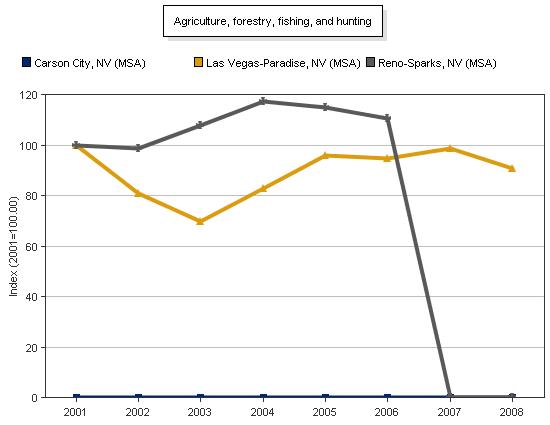
Although the chart is labeled Agriculture, Forestry, Hunting and Fishing, we can rule out the last three and focus on agriculture within city limits. Whether this chart shows the disappearance of open space in the south meadows or ranch land in the north valleys would take some research. But, seeing as how that disappearance happened right at the top of the real estate boom, one thing we can say with absolute certainty is - Mama didn't raise no fool out there on the farm!
Both of these websites are a gold mine of local information from credible, unbiased sources. The entire experience of the workshop seems to me the way things ought to be; a university offering knowledgeable, experienced speakers to anyone who wants to listen, a government department genuinely interested in providing useful information to the people, and a retired professor taking it upon himself to educate the general public. It was a very positive experience all around.
The Regional Economic Analysis Project (REAP) is the brainchild of retired professor Gary Smith of Washington State University. Along with the charts and tables, REAP includes analysis on what things mean, and just as important, what they don’t mean. Just poking around on it, I found several cautionary tales of other numbers to check before reaching a conclusion. Being the work of a former professor, REAP is as much a teaching tool as a source of information. The site is arranged by state, county, and regions (groups of counties).
From the main page, click on Nevada. This brings you to a drop down menu of economic categories, and after choosing one, you get a list on the right of counties and regions. Here's the per capita income of Washoe County. It has the added bonus of showing inflation. The blue line shows actual dollars while the red line shows inflation adjusted dollars (buying power).
Here's our region showing Washoe, Carson, Story, and Douglas Counties. The numbers are slightly different, but the trends are the same.
This chart shows the earnings per job in Washoe County and Nevada. 100% is the national average and is used as the baseline. This chart comes with a cautionary tale. Since it measures both full and part-time employment, sometimes a rise in part-time jobs can cause a decrease in the overall average. One would have to look through the employment numbers before reaching a conclusion.
There are ways to combine the charts and tables, but I'm still just poking around here. Did I mention I take lousy notes? Luckily, there are instructions, and Dr. Smith is happy to help.
Alison Adam heads up the Bureau of Economic Analysis website. She was at the workshop to explain the new inter-active features. From the main page, click on Regional and then quick links. This brings you to the inter-active menu. At the bottom is Local Area Personal Income and Employment. Click on charts and that brings you to a design-your-own section. Again, just poking around to see what I could find, I made this one.
Although the chart is labeled Agriculture, Forestry, Hunting and Fishing, we can rule out the last three and focus on agriculture within city limits. Whether this chart shows the disappearance of open space in the south meadows or ranch land in the north valleys would take some research. But, seeing as how that disappearance happened right at the top of the real estate boom, one thing we can say with absolute certainty is - Mama didn't raise no fool out there on the farm!
Both of these websites are a gold mine of local information from credible, unbiased sources. The entire experience of the workshop seems to me the way things ought to be; a university offering knowledgeable, experienced speakers to anyone who wants to listen, a government department genuinely interested in providing useful information to the people, and a retired professor taking it upon himself to educate the general public. It was a very positive experience all around.
Monday, October 5, 2009
The Economic Workshop At UNR (Part 1 of 2)
On Tuesday I attended the “Navigating Nevada’s Economy Workshop” hosted by UNR. As far as I could tell, with the exception of a UNR camera crew who stopped by for a quick interview, I was the only member of the media present. Too bad, the workshop offered a powerhouse line-up of speakers from both government and academia focusing on our area’s economy. Economists, teachers, and computer programmers from the Bureau of Economic Analysis
(BEA) and the Regional Economic Analysis Project (REAP) combined to explain how data is collected, the analysis of that data, and how their websites are arranged. Both websites are inter-active and look to be very useful to anyone, in or out of government, interested in our local economy. Apparently, the local traditional media isn’t that interested.
Two big idea’s I came away with from the workshop were the problems and solutions to understanding an economic region. The other idea that was unstated, but occurred to me later, was the disconnect between economists and the media.
Data can only be collected by city, county, and state, but no-one in the public makes decisions based on lines on a map. Gary Smith, a retired professor from Washington State University and the driving force behind REAP, introduced the idea of “the State of Sierra.” In order to understand economic numbers, one has to take into account the fact that people travel. This is not just true with tourism. We might live in one town and work in another, crossing city, county, and state lines, producing and spending along the way. Simply looking at Reno’s numbers will only tell you so much about Reno’s economy. In order to reach an understanding, one has to look beyond Reno. I’ll explain more about this in Part 2 where I will attempt to demonstrate the REAP and BEA inter-active websites.
After I got home and was mentally digesting all that I had seen and heard, I started thinking about 2 things. One was Rob Brown’s presentation about the timeline in which economic data is received. The other was Mallory Rahe’s demonstration of using economic data to tell a story.
From time to time one can find stories in the press of inaccurate government figures or “inept unelected bureaucrats”. I’ll admit, taking shots at the government can be great fun, and more importantly one of the things that insures a free and independent press. However, when it comes to government revisions of economic numbers, it’s important to know the timeline by which the numbers are gathered in order to tell the story with any degree of accuracy. For instance, home foreclosures are known quantities within a month, but personal income is received via the IRS and is from the previous year. Information becomes more accurate as the information is gathered. Economists have to arrive at some initial conclusions using estimates sometimes derived by inference. It is only over time that hard data becomes available and estimates become known quantities. This is not only critical to telling an accurate story, but also in separating the truth from political cheerleading.
I could go on about other presentations, the RIMS II program which helps gauge the economic impacts of proposed developments, Dr. Keith Schwer‘s extensive study of Nevada and why he believes our state will lag behind in any recovery, an inside look at the Federal Reserve from a Fed economist, and general discussions of methodology. The depth of knowledge by each of the speakers was truly impressive. This was my second workshop at UNR within the last year and both were excellent - well worth the time, effort, and expense. Tomorrow we’ll look at some of the features of the REAP and BEA websites.
(BEA) and the Regional Economic Analysis Project (REAP) combined to explain how data is collected, the analysis of that data, and how their websites are arranged. Both websites are inter-active and look to be very useful to anyone, in or out of government, interested in our local economy. Apparently, the local traditional media isn’t that interested.
Two big idea’s I came away with from the workshop were the problems and solutions to understanding an economic region. The other idea that was unstated, but occurred to me later, was the disconnect between economists and the media.
Data can only be collected by city, county, and state, but no-one in the public makes decisions based on lines on a map. Gary Smith, a retired professor from Washington State University and the driving force behind REAP, introduced the idea of “the State of Sierra.” In order to understand economic numbers, one has to take into account the fact that people travel. This is not just true with tourism. We might live in one town and work in another, crossing city, county, and state lines, producing and spending along the way. Simply looking at Reno’s numbers will only tell you so much about Reno’s economy. In order to reach an understanding, one has to look beyond Reno. I’ll explain more about this in Part 2 where I will attempt to demonstrate the REAP and BEA inter-active websites.
After I got home and was mentally digesting all that I had seen and heard, I started thinking about 2 things. One was Rob Brown’s presentation about the timeline in which economic data is received. The other was Mallory Rahe’s demonstration of using economic data to tell a story.
From time to time one can find stories in the press of inaccurate government figures or “inept unelected bureaucrats”. I’ll admit, taking shots at the government can be great fun, and more importantly one of the things that insures a free and independent press. However, when it comes to government revisions of economic numbers, it’s important to know the timeline by which the numbers are gathered in order to tell the story with any degree of accuracy. For instance, home foreclosures are known quantities within a month, but personal income is received via the IRS and is from the previous year. Information becomes more accurate as the information is gathered. Economists have to arrive at some initial conclusions using estimates sometimes derived by inference. It is only over time that hard data becomes available and estimates become known quantities. This is not only critical to telling an accurate story, but also in separating the truth from political cheerleading.
I could go on about other presentations, the RIMS II program which helps gauge the economic impacts of proposed developments, Dr. Keith Schwer‘s extensive study of Nevada and why he believes our state will lag behind in any recovery, an inside look at the Federal Reserve from a Fed economist, and general discussions of methodology. The depth of knowledge by each of the speakers was truly impressive. This was my second workshop at UNR within the last year and both were excellent - well worth the time, effort, and expense. Tomorrow we’ll look at some of the features of the REAP and BEA websites.
Sunday, September 27, 2009
World Record Jump Video
As part of the Street Vibrations event in Reno Saturday, Ryan Capes set a new world record for motorcycle jumping at the Grand Sierra Resort.
I arrived at about 4 PM and the jump was scheduled for 6. There weren't many people there yet, so I had my choice of a long shot or a close-up. Since I had beat the crowd, and there were a lot of trees and lamp posts to shoot around, I went for the close-up near the take-off ramp.
Ryan made a number of practice runs, veering off at the last second, to get the speed right. His first jump was 287 feet, which set a new world record. Things were going well enough that he decided to try for 300.
I arrived at about 4 PM and the jump was scheduled for 6. There weren't many people there yet, so I had my choice of a long shot or a close-up. Since I had beat the crowd, and there were a lot of trees and lamp posts to shoot around, I went for the close-up near the take-off ramp.
Ryan made a number of practice runs, veering off at the last second, to get the speed right. His first jump was 287 feet, which set a new world record. Things were going well enough that he decided to try for 300.
Tuesday, September 22, 2009
The Renegade Fed
A major split has developed between the Treasury Dept. and the Federal Reserve. Fed Chairman Ben Bernanke has denied a request from Treasury Secretary Tim Giethner for a public review of the Fed's structure and governance. Earlier this year the Fed denied a similar request from congress. According to American Banking News:
Ironically, even with the Feds bogus claims of independence, many of the regional fed chairman were initially in favor of the review. They have now closed ranks and will be fighting against it. The Feds insistence on independence and secrecy, combined with the mounds of taxpayer money they are spending, is slowly isolating it.
Together with HR 1207, which would audit the Federal Reserve and currently has 290 cosponsors in the House, S.604 in the Senate has 27 cosponsors. Senators as diverse as Orrin Hatch of Utah and Barbara Boxer of California have signed on. Neither Nevada Senator Reid or Senator Ensign have said a single word about it. One might think that being on the side of the people would give either one a much needed PR boost. We'll see.
Much of the impetus behind this initiative from the Treasury Department came from concerns over Ben Bernanke going far beyond his delegated authority, to bail out businesses like those in the auto industry, along with AIG and Bear Stearns, which aren’t part of its mandate. Of course bailing out the financial industry isn’t part of its mandate either, but these other industries are easier to identify as obvious to not being related to the Federal Reserve and its stated purpose.
Ironically, even with the Feds bogus claims of independence, many of the regional fed chairman were initially in favor of the review. They have now closed ranks and will be fighting against it. The Feds insistence on independence and secrecy, combined with the mounds of taxpayer money they are spending, is slowly isolating it.
Together with HR 1207, which would audit the Federal Reserve and currently has 290 cosponsors in the House, S.604 in the Senate has 27 cosponsors. Senators as diverse as Orrin Hatch of Utah and Barbara Boxer of California have signed on. Neither Nevada Senator Reid or Senator Ensign have said a single word about it. One might think that being on the side of the people would give either one a much needed PR boost. We'll see.
Friday, September 18, 2009
Bernanke's Inflated Market
There's not much argument that Ben Bernanke has been one of the more active Federal Reserve Board Chairmen. The "cash injections", covert buys of Treasury Notes, and some rather strange occurrences in the metals markets over the past year, has everyone outside the CNBC cheerleaders wondering if this stock market rally is real. A look at the straight line gain in the S&P 500 since March is reminiscent of the kind of charts convicted hustler Bernie Madeoff used to produce.

The tip-off that the recovery may not be as certain as claimed is found in crude oil prices. Crude oil started its predictable fall in August, but then a strange thing happened; instead of the typical post Labor Day crash, it went back up.

With gold over $1,000/oz., and Treasury bonds selling at auction at a brisk pace, it would seem that everybody is buying everything; Let the good times roll. Except, it can all be explained by a weakening currency.

Rising prices are only the result of reduced buying power of the dollar. If that's not inflation, then what is?

The tip-off that the recovery may not be as certain as claimed is found in crude oil prices. Crude oil started its predictable fall in August, but then a strange thing happened; instead of the typical post Labor Day crash, it went back up.

With gold over $1,000/oz., and Treasury bonds selling at auction at a brisk pace, it would seem that everybody is buying everything; Let the good times roll. Except, it can all be explained by a weakening currency.

Rising prices are only the result of reduced buying power of the dollar. If that's not inflation, then what is?
Monday, September 14, 2009
End The Fed: A Review
Congressman Ron Paul's new book, "End The Fed" is an excellent book, especially if you're of a libertarian mind. If not, there are still several good arguments for the abolition of the Federal Reserve Bank that could have mass appeal. Speaking as one who was sympathetic with Dr. Paul's rEVOLution in 2008, I can see that this book could be written off as the work of a crackpot by Dr. Paul's opponents. The good doctor just can't help himself from wandering off the main subject and onto some of the more esoteric avenues of libertarian philosophy. That's unfortunate as there is a core of truth here that non-libertarians need to realize.
The book starts with a simple explanation of what fractional reserve banking is and how it works. This is worth the price of the book all by itself. The idea that debt can be used as a form of collateral is central to the inherent dishonesty and ultimate instability of the system. It causes money to become unnaturally "elastic". Far from creating wealth as its proponents claim, this elasticity only creates the illusion of wealth. It causes new money to be created, but there is no corresponding new labor, no new production, and no new assets. This is the very definition of inflation. The ability to create inflation is the root cause of political favoritism, crony capitalism, corruption, military adventurism, massive public debt and a host of lesser ills.
An honest currency is a benefit to any honest person, no matter one's political stripe. The economics of a sound currency cannot be separated from its moral justification. An honest dollar breeds honest business dealings, honest government, and an honest society. Accounting tricks and false promises breed suspicion and distrust. It's no coincidence that even socialist Senator Bernie Sanders is on board with the idea. I doubt if it was the free market argument or the strict interpretation of the Constitution that persuaded him. I can only surmise that it was the moral argument that he found convincing. The great mass in the middle could be persuaded as well.
Some may be asking, "If we abolish the Federal Reserve, what do we replace it with?" The answer is the same thing that all 50 state governments have, and every county and city government too; Nothing. Governments do fine with taxes, fees and bonds. There is no reason why the Federal Government could not do the same. Regulation of the money supply could easily be handled by the Treasury Department, which unlike the Federal Reserve, is accountable to the people.
The Federal Reserve Bank has been the bane of libertarians for decades. There are plenty of valid reasons outside of libertarian philosophy to abolish it. With the current financial mess, the Fed's record of failure is now apparent to all, and there is no simple reform or granting of new powers that will change that. This is no time to be preaching to the choir. It's the other 98% of America that needs to hear this, and now that we have their attention, it's important to remember the first rule of business: Don't scare the customer.
The book starts with a simple explanation of what fractional reserve banking is and how it works. This is worth the price of the book all by itself. The idea that debt can be used as a form of collateral is central to the inherent dishonesty and ultimate instability of the system. It causes money to become unnaturally "elastic". Far from creating wealth as its proponents claim, this elasticity only creates the illusion of wealth. It causes new money to be created, but there is no corresponding new labor, no new production, and no new assets. This is the very definition of inflation. The ability to create inflation is the root cause of political favoritism, crony capitalism, corruption, military adventurism, massive public debt and a host of lesser ills.
An honest currency is a benefit to any honest person, no matter one's political stripe. The economics of a sound currency cannot be separated from its moral justification. An honest dollar breeds honest business dealings, honest government, and an honest society. Accounting tricks and false promises breed suspicion and distrust. It's no coincidence that even socialist Senator Bernie Sanders is on board with the idea. I doubt if it was the free market argument or the strict interpretation of the Constitution that persuaded him. I can only surmise that it was the moral argument that he found convincing. The great mass in the middle could be persuaded as well.
Some may be asking, "If we abolish the Federal Reserve, what do we replace it with?" The answer is the same thing that all 50 state governments have, and every county and city government too; Nothing. Governments do fine with taxes, fees and bonds. There is no reason why the Federal Government could not do the same. Regulation of the money supply could easily be handled by the Treasury Department, which unlike the Federal Reserve, is accountable to the people.
The Federal Reserve Bank has been the bane of libertarians for decades. There are plenty of valid reasons outside of libertarian philosophy to abolish it. With the current financial mess, the Fed's record of failure is now apparent to all, and there is no simple reform or granting of new powers that will change that. This is no time to be preaching to the choir. It's the other 98% of America that needs to hear this, and now that we have their attention, it's important to remember the first rule of business: Don't scare the customer.
Tuesday, September 8, 2009
Recession: Round Two
Six months ago economists and financial experts debated three scenarios; 1) the stimulus would take until September to pull us out of recession, 2) the stimulus would be good short term, but after September it was anyone's guess, and 3) after September the stimulus would be over and the economy would get worse. The next few months will determine who gets bragging rights.
Many analysts are saying the recovery is "in sight", or "around the corner", but this amounts to so much wishful thinking for several reasons. Two things about the recent run-up in the stock market have been the low volume and the complete absence of small investor. Institutions, professional traders, and possibly cash injections from the Fed have been the only players so far. Without congressional reform of the system, there is no reason for the small investors to get back in the game.
Whatever one's opinion of the cash-for-clunkers program, one thing is certain; it's now over. Detroit will have to get back to selling cars the old fashioned way. New home buyers and people refinancing have largely played themselves out. Delinquencies on loans are still rising. The housing market is set for another stall. There are still the commercial real estate and credit card markets that haven't come into play yet.
At some point the Fed is going to pull the plug on the bailout bonanza and when they do, a lot of investors will pull the plug with them. Sooner or later, the Fed will also need to raise interest rates, unless the plan is the complete destruction of the dollar as a viable currency. Raising rates in a downturn is what they were hoping to avoid, but it looks like they have only postponed the day of reckoning.
I wish I could be optimistic. I used to enjoy playing the stock market and I hope to get back in one day. But, I see more hard times ahead. Good luck everybody.
Many analysts are saying the recovery is "in sight", or "around the corner", but this amounts to so much wishful thinking for several reasons. Two things about the recent run-up in the stock market have been the low volume and the complete absence of small investor. Institutions, professional traders, and possibly cash injections from the Fed have been the only players so far. Without congressional reform of the system, there is no reason for the small investors to get back in the game.
Whatever one's opinion of the cash-for-clunkers program, one thing is certain; it's now over. Detroit will have to get back to selling cars the old fashioned way. New home buyers and people refinancing have largely played themselves out. Delinquencies on loans are still rising. The housing market is set for another stall. There are still the commercial real estate and credit card markets that haven't come into play yet.
At some point the Fed is going to pull the plug on the bailout bonanza and when they do, a lot of investors will pull the plug with them. Sooner or later, the Fed will also need to raise interest rates, unless the plan is the complete destruction of the dollar as a viable currency. Raising rates in a downturn is what they were hoping to avoid, but it looks like they have only postponed the day of reckoning.
I wish I could be optimistic. I used to enjoy playing the stock market and I hope to get back in one day. But, I see more hard times ahead. Good luck everybody.
Thursday, September 3, 2009
JP Morgan/Chase Bails Out California
California's much heralded IOU's will be redeemable with interest at Bank of America between Sept. 9th and Oct. 9th. Wells Fargo will accept them between Sept. 4th and Sept. 30th, but will only credit interest above $5.00. According to American Banking News, three other banks, Citibank, Bank of the West, and Union Bank have announced similar programs, but no dates or particulars are given. IOU's can also be redeemed at the Treasurer's office in Sacramento, or by mail at Attn: Registered Warrant Desk, 915 Capitol Mall, Sacramento, CA 95814.
In lieu of tax refunds, California handed out 457,238 IOUs totaling more than $2.37 billion between July 2nd and August 31st. The State of California has now received a "cash-flow infusion" courtesy of JP Morgan/Chase of $2.8 Billion. All of which raises an interesting question: If the State of California fails to make its payments to JP Morgan/Chase, could the bank the start foreclosure proceedings on the state, and throw the government out in the street? Just asking.
In lieu of tax refunds, California handed out 457,238 IOUs totaling more than $2.37 billion between July 2nd and August 31st. The State of California has now received a "cash-flow infusion" courtesy of JP Morgan/Chase of $2.8 Billion. All of which raises an interesting question: If the State of California fails to make its payments to JP Morgan/Chase, could the bank the start foreclosure proceedings on the state, and throw the government out in the street? Just asking.
Subscribe to:
Posts (Atom)


 Posts
Posts

