Showing posts with label Economy. Show all posts

Tuesday, July 13, 2010

How to build a corporate state using a simple yield curve

In a strange twist of fate, I've begun to cheer for the Democrats. My thinking is that the faster they build their progressive utopia, the sooner rational people will see it for the Orwellian nightmare that it is. Many Republicans believe this is already happening, and all will be well in November. I believe it will take longer, mainly because the Republicans seem to be helping them.

Just to make sure we're all starting on the same page, here's a quick and easy explanation of the yield curve.
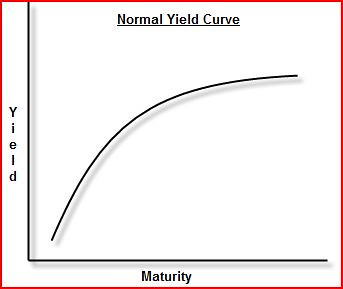
textbook yield curve
The maturity on the bottom is the time element. The yield is the promised return on the investment. The longer the time, the greater the risk, and therefore, the higher the return. You don't need to calculate the yield to understand the curve. I told you it was easy.

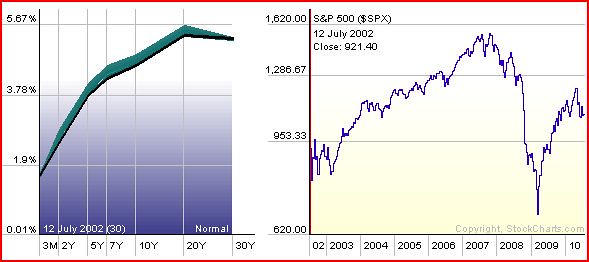
There's a terrific animated chart on stockcharts.com that compares the yield curve on government bonds with the S&P 500. The last 8 years provide a good demonstration of the yield curve's importance. I can't bring the animation here, but the site encourages people to take screenshots. And, now that I've successfully navigated the Microsoft labyrinth and found the magic snipping tool, we can look at some.

yeild curve-sp 702
We start our latest round of corporate-nation building in mid July of 2002. On the left, the black line is the yield curve, and the gray areas show the movement and velocity. At this time, the yield curve is in near perfect formation. The chart on the right is the S&P 500. We can see that in 2002, the S&P was just bumping along in no particular direction. Short term investors were having a hard time outguessing which way it would go, and long term investors weren't making anything. Nobody was happy. Stability breeds boredom.
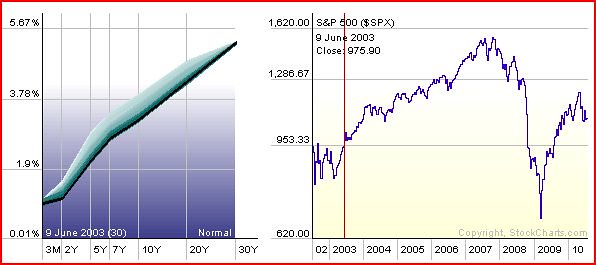

yeild curve mid 03
June of 2003: In an effort to get things moving, the Federal Reserve steps in and lowers short term interest rates (dropping the yield). This causes investors to move their money from treasury bills and other short term bonds into the stock market. The S&P hits new highs, and the rally is on. Long term rates remain the same to help home buyers. This move was wildly applauded by nearly everyone at the time.

yeild curve 05
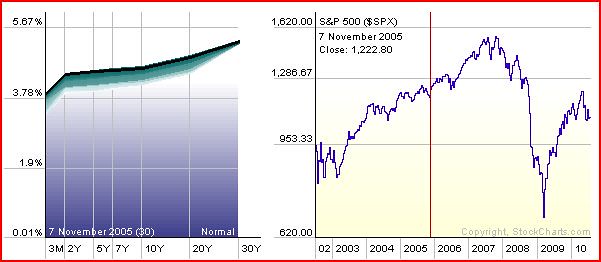
November of 2005: With the rally sustained, the Fed raises short term interest rates. They do this to prevent what Alan Greenspan once dubbed "irrational exuberance". Having started the rally, they now try to dampen the enthusiasm for it. On the S&P chart, notice the stair step nature of the upward momentum, with double and triple peaks followed by minor sell-offs. Each incremental increase in rates by the Fed causes a few investors to exit the stock market. A general upward trend continues as Keynes' "animal spirits" are still in the majority.

yeild curve 06 flat
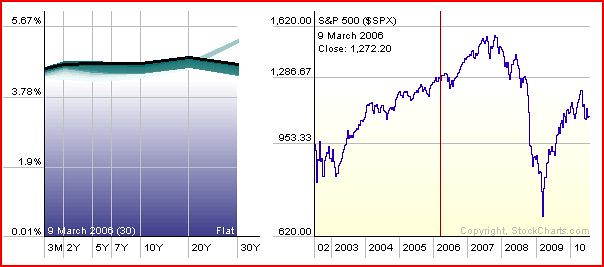
March of 2006: The first sign of trouble, the yield curve turns flat. It's generally considered to be a precursor of an economic transition. Still, it's only one negative sign in a field of positives. The rally continues.

yeild curve inverted 06
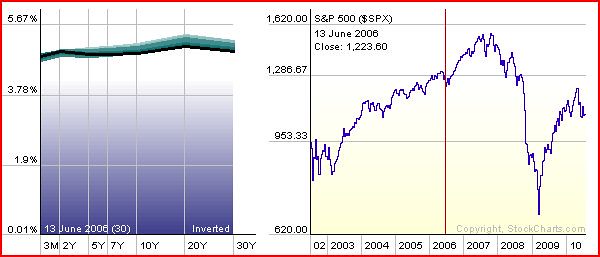
June of 2006: An ominous sign. The yield curve is now inverted with short term yields paying more than longer term yields. The previous 6 recessions were preceded by an inverted yield curve. "Not to worry", say the talking heads, "we've had inversions without recessions, and recessions without inversions before. 6 straight doesn't necessarily mean there will be a 7th." They're right, of course, it doesn't. In fact, the longer a trend is, the less likely it will continue.

second inversion
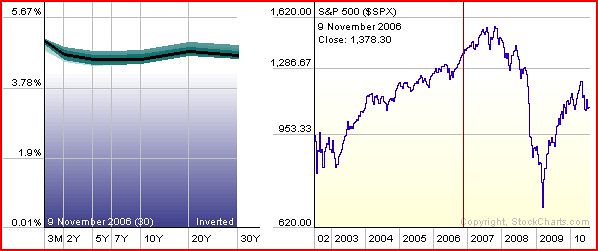
November of 2006: The yield curve flattens and inverts again. This time, it's more pronounced and unmistakable. Talk in the press of an impending recession becomes more numerous. The "doom and gloom" forecasters are largely ignored.
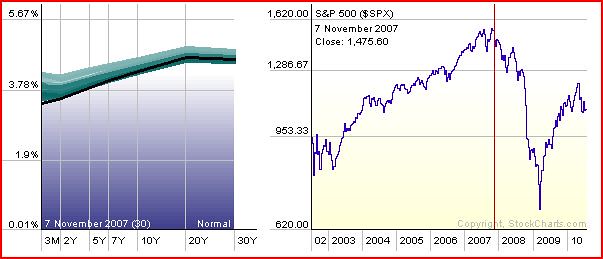

yeild curve double peak
November of 2007: The S&P 500 is at the tail end of a major double peak formation, suggesting the years-long rally has lost its momentum. The Fed begins lowering interest rates to keep the rally going, or at the very least, produce a "soft landing." With short term yields still relatively high, the smart money exits the stock market.
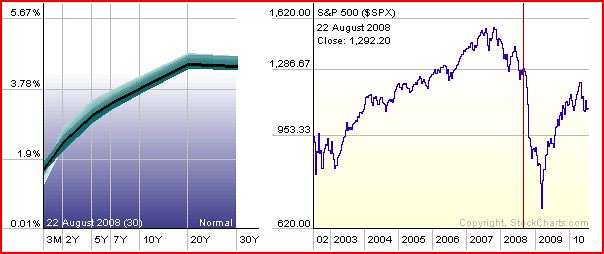

yeild curve before the fall
August of 2008: The Bush stimulus in the spring helps with a small upward spike, but the major sell-off continues. Worst of all, as we now know, is many company's borrowed heavily on the way up. With prices falling and investors becoming scarce, they are now strapped for cash. As the old saying goes, "Adventure is the result of bad planning." But dude, check out that good lookin' yield curve!
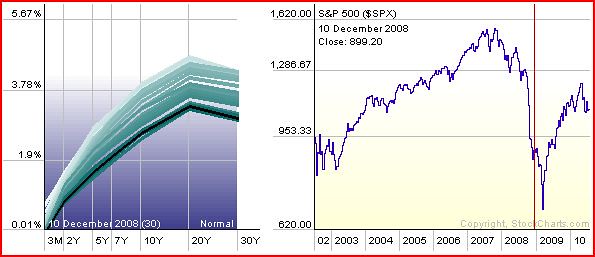


panic 08
December of 2008: This is what a panic looks like. It's hard to say who's having the greater adventure here, corporate officers, stock market investors or Federal Reserve officials. Interest rates hit zero, and $400 dollars invested in a 3 month Treasury Bill now brings a profit of 1 cent. Even that won't get money back into the stock market.


curve at the bottom
March of 2010: The S&P 500 hits bottom. The stimulus plan was passed in February and together with the government's buying of millions of shares of stock, we have a new meaning to the term "corporate welfare." We might also note that with interest rates at zero, an inverted yield curve is impossible. A flat curve, while theoretically possible, isn't very likely. As a predictive tool, the yield curve is now a meaningless relic. Government manipulation of interest rates is over, for the time being.


curve today
June of 2010: So, here we are today, with the S&P a couple of hundred points above where we started and heading down.

On the political left, there are calls for another round of stimulus and government buying of private debt. This has the unhealthy side effects of ever more federal debt and government ownership of for-profit industry (corporatism). I can't be the only one who noticed that the last round of stimulus did wonders for the stock market while doing nothing for the unemployed; and this from the Party of the Common Man.

On the right are the inevitable calls for tax cuts to "promote growth." Aggregate debt for the S&P alone is over $2.5 Trillion. Are there enough taxes to cut to make up for that much? I don't know, but forget the scissors, better fire up the chainsaw.

All across the political spectrum is a small but growing minority that wants to dump the Federal Reserve altogether. While this won't solve the current dilemma, it might prevent another one. After all, it only took 8 years from the Fed's creation (1913) to the first recession (1921), and 16 years to the first crash (1929). Their record since has been marginally better, but remember, they're supposed to be maintaining stability.

Historically, the stock market is pretty quiet through the summer, and if there is to be another plunge, it would happen in October. Second quarter earnings reports will be released over the next few weeks. We will soon know whether we will have a quiet summer, or an adventurous one; a work stoppage, or more building.
Sunday, July 4, 2010

Masters Of Delusion

I believe that this nation should commit itself to achieving the goal, before this decade is out, of landing a man on the moon and returning him safely to the earth.
John Kennedy

Putting a man on the moon was easy. What people often forget is that doing so without killing him was the hard part. Fooling Mother Nature is always a temporary project. July 20th will mark the 41st anniversary of the greatest trick humanity has ever played on Mother Nature. Like all anniversaries indivisible by 10, it will pass largely unnoticed.

What is being noticed is that the long predicted collapse of the engineered economic order is about to be realized. It’s gotten so bad that even Paul Krugman is noticing. Robert Samuelson, the 2nd smartest guy in economics, is noticing too. Hopefully, the peasantry is noticing that economics is not engineering.

What really got the economists attention was the continuing problems in Greece. In spite of multiple promises of “austerity measures”, and bailouts by a variety of governments and institutions, Greek bond rates are still rising. How can this be? The people with credentials have studied the problem and made their decisions. The policy prescriptions have been put in place, so everything will be ok, right?

As always, there is one thing missing from the equations produced by the would-be Masters of Capital Markets; the peasant class.

I’ve commented many times over the last 2 years about the disappearance of the small investor. (Being a blogger, and therefore one step below a journalist, I’m far too lazy to dig through the archives, so you’ll just have to take my word for it). Disappearance may have been too strong a word, as rising gold and silver prices are a good indication of where he has gone. Precious metal prices are also an indication of the amount of trust in one’s leaders. Like the millions of jobs that became obsolete in the last 2 years, trust shows no sign of making a comeback.

The reasons for this lack of trust are many. The most recent example was nicely demonstrated by Nancy Pelosi when speaking of unemployment checks:

This is one of the biggest stimulus’s to our economy, economists will tell you…it injects demand into the economy…


Even the simplest logic seems to escape both economists and politicians alike. Why not just hand out money to business people and skip the middleman? Oh wait, that was the first and second stimulus. Do you get the impression that if they could nationalize the unemployed, they would? It is one of modern life’s mysteries why so many smart people, who themselves are doing well financially, can’t see the difference between credit and wealth. Perhaps it is because we have been on the Federal Reserve system for so long, they can’t imagine things being any other way.

I know there are some who can’t stand song lyrics in blog posts, but I just can’t resist an old Jethro Tull* favorite.

The excrement bubbles,
The century slime decays,
And the brain-washing government lackey’s
Would have us say,
“It’s under control
And we’ll soon be on our way
To a grand tea for babies
And quiz panel games,
Of the heart-hungry millions
You’ll be sure to remain.”
The natural resources are dwindling
And no-one grows old.
And those with no homes to go to,
Please dig yourselves a hole.

Like the Apollo astronauts preparing for their return, our fate is dependent on the plan made long before. Our current national bank will soon inflate itself out of existence, the same way our country's first three national banks did.

Unlike the astronauts, our plan did not include a safe return, only constant trickery by delusional economic engineers. Our return to earth will not be a joyous occasion. We would do just as well placing our trust in the hands of poets.

*from Wondrin' Again

Thursday, December 3, 2009

Book Review: The Return Of The Great Depression

Ordinarily, I bypass books with prophetic titles. In the case of The Return Of The Great Depression by Vox Day, I was willing to make an exception. I've been lurking on Vox's Blog for years, as well as reading his WND columns, and like most bloggers who have been around for years, he can be counted on to at least be thought provoking. Vox has an eclectic set of interests and his writings are where I was introduced to the Austrian school of economics.

Unlike the Keynesianism, which has made a comeback lately, and the Chicago school of monetarism, which has recently failed, the Austrians place subjectivity as the most important idea when trying to understand an economy. The battle between the scientific, or political economists as Vox calls them, and the philosophical economists, who emphasize logic rather than statistics, seems to me to be the main difference between them all. The Austrians and their offshoots are definitely in the philosophical camp.

As I've grown older, I have come to the realization that nobody really knows anything, so I wasn't too surprised when I got to Chapter 4 entitled, "No One Knows Anything." It is here where Vox's use of logic really shines. He dissects Gross Domestic Product (GDP), Gross National Product (GNP), and Unemployment numbers (U-3, U-6), and shows how subjective these statistics really are. They all begin with a set of assumptions about future events, then categorized by what the economist believes to be already true. Should any one assumption become untrue, or categorization turn out to be misplaced, the statistic will need to be revised. Since these statistics are revised all the time, this chapter should be required reading for anyone who has ever believed anything in the mainstream press.

For the more politically minded, anyone still wondering what all the fuss over Ron Paul was about last year, this book provides the answers. It includes the best argument from the right against Reagan era monetarism that I've ever read. Like Keynesianism, monetarism requires government intervention and top-down management of the economy. For those on the left, former Labor Secretary Robert Reich comes through looking fairly reasonable, while Paul Krugman's critique of Austrian theory is mercilessly dismembered point by point. There is also a nice section on the early development of Austrian theory, it being a response to the German scientific method that was being adopted by 20th Century fascists.

For myself, I tend to gravitate towards the philosophical rather than the scientific for the simple reason that it is easier to understand. That doesn't mean they're right. To his credit, Vox goes out of his way to explain the various ways he could be wrong. This book is an honest and multi-faceted look at our current situation. We may or may not suffer a full blown depression, but one thing is certain; debt can either be paid (deleveraged) or not paid (defaulted). In either case, we have a hard time ahead. Whether it is next year or next decade, at some point the music stops, the dance ends, and the band will want what is due.

Sunday, November 22, 2009

Book Review: Keynes, The Return Of The Master

It's good practice to pick up a book, from time to time, that you know you're going to disagree with. Knowing why you favor one idea over another requires knowing both. This was the reason why I read Keynes: The return of the master by Robert Skidelsky.

Having already written a three volume biography of Keynes, Skidelsky covers a lot of territory in 193 pages. In order to understand how Keynesianism might help us today, one must first understand Keynes the man, the times in which he lived, and his historical role. Skidelsky does an excellent job with the grand sweep of history and fleshing out Keynes the man. It is only when he is trying to explain today's muddled situation, with floating exchange rates and complex international savings/investment relationships that the book loses its rhythm.

Keynes was not just an economist. He was a philosopher whose main interest was economics. His moral philosophy was conventional, even Victorian by today's standards. He was an unapologetic capitalist who set out to solve what he saw as capitalism's biggest problem; unemployment. He lived at the dawn of modernity, the industrial revolution was in full swing, and the rise of communism and fascism were real threats to capitalist democracies. If a way could be found to maintain low unemployment, it would lead to a more harmonious world.

Among economists, both then and now, Keynes's greatest, and most controversial insight, was realizing the difference between risk and uncertainty. Risk is quantifiable. Risk can be managed using math and science. Our reasoning abilities can be used to predict the future with a fair degree of accuracy. But scientific risk management will only get us so far. Uncertainty is more like an enveloping fog, thick in some parts, thinner in others, always obscuring our expectations of what the future will bring. In a world of uncertainty, we make progress by trial and error, reverting to convention to get us through the mysterious shroud. When the most logical path is hidden and unknowable, scientific reason is of no practical benefit.

This does much to explain our present situation. Our computer models have failed us. Our reasoning abilities have become useless at predicting what is to come next, and so we revert to Keynes. He got us through this before, he can do it again.

There is a lot to like about Keynes. He seems to have been a kindly old gent, a revolutionary and independent thinker. Skidelsky points out that all the schools of economic thought have some amount of real world truth. The economics of capitalism is very much a work in progress. I still think my disagreements with Keynes are still valid, like a high savings rate represents a failure of growth, rather than an increase in real wealth, or that flooding the markets with depreciating cash will produce an overall good. Most of all, like all people of the political left, Keynes tends to assign greed, avarice, and self-interest only to the business class. The political class is assumed to be altruistic and working for the benefit of all. I have to think that if Keynes were alive today, he would be reconsidering that assumption.

I recommend this book for the general reader. Skidelsky writes in plain language and for the most part, treats his adversaries fairly. I would have liked it more if he had spent more time on the collapse of the Bretton-Woods Agreement and the resulting inflation, but maybe he'll have more to say about that in the next one.

Sunday, October 25, 2009

Globalization's Downward Spiral

In 6,000 years of recorded human history there has never been a country, or an empire, that grew strong with a weak monetary system. The fall of empires is always foreshadowed by devaluation; Always. From Byzantines byzant, to Rome's drachma, to England's pound, the deliberate cheapening of the money marks the beginning of the end.

I think of this when I read in the financial press about how the falling dollar is good for exports, a fact that is technically true. They say higher exports will lead to recovery because of the global market. Countries are in a race to out-export each other, and we have to compete. Meanwhile, the working poor and lower middle class see the price of bread and shoes rise, and wonder why.

To his credit, Donald Luskin at least mentions the working poor, if only in passing.
It doesn’t take a genius to figure out the winners and losers on this score. If you buy cheap Chinese-made goods at Walmart, you’re going to be a loser. Prices are going up.

The fact is that with a sinking dollar everybody loses, the Walmart shoppers are only the first in line. This isn't just a screed for the bleeding heart liberals either. The ability of the working poor to acquire necessities is the foundation on which all else is built. When the poor go without, the middle class lose their jobs, and then who's shopping at Walmart?

And there's no safe haven in the booming stock market either. As Luskin himself points out:
This year’s 15 percent dollar drop began on March 9, the very day the stock market found its bottom. Tick for tick, the dollar’s decline has tracked the stock market’s monster rally.

But it's not a sign of recovery as Luskin concludes. Like gamblers who only talk of their winnings, the bulls on Wall Street never mention the 15% haircut. For them, the rise pads the bottom line, and the government gets to claim credit for improving conditions. Statistics are about quantity, not quality.

On our current trajectory, the dollar will hit an historic low sometime around Christmas. My guess is, they'll blame the lack of retail sales on consumers.

Tuesday, October 13, 2009

Traditional Media Win The So-What Prize

Now that the who-haw over President Obama's winning of the Nobel Peace Prize is subsiding, was the story really that big of a deal? Is it so big that the traditional media needs to spend the better part of a week on it? It seems everyone is trying to find some greater meaning from a mostly meaningless prize. Was this really news, or a manifestation of the herd mentality? OK, so he hasn't really done anything to deserve it. So what? It's their prize, they can give it to anyone they want to, and for any reason.

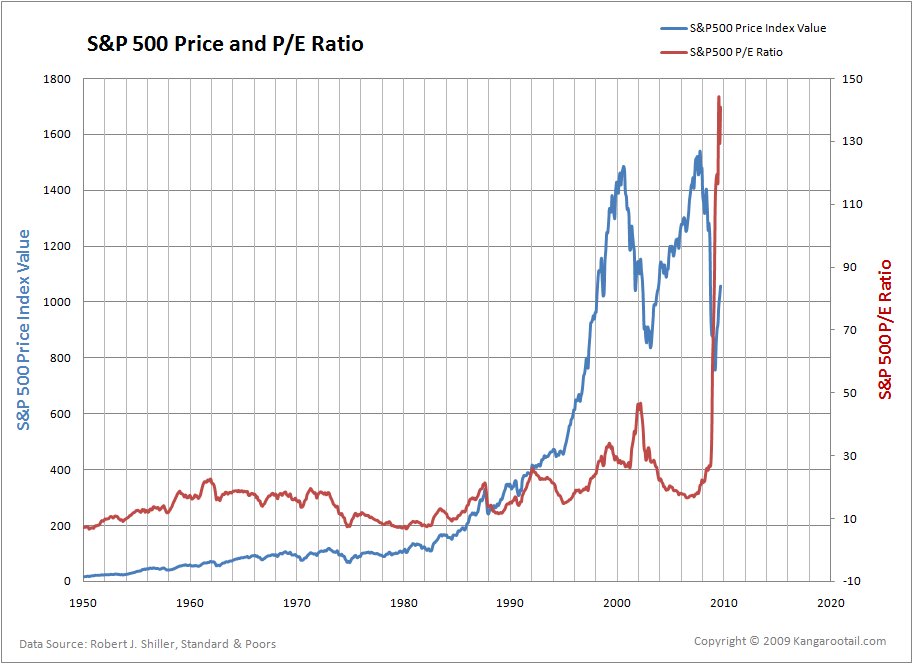
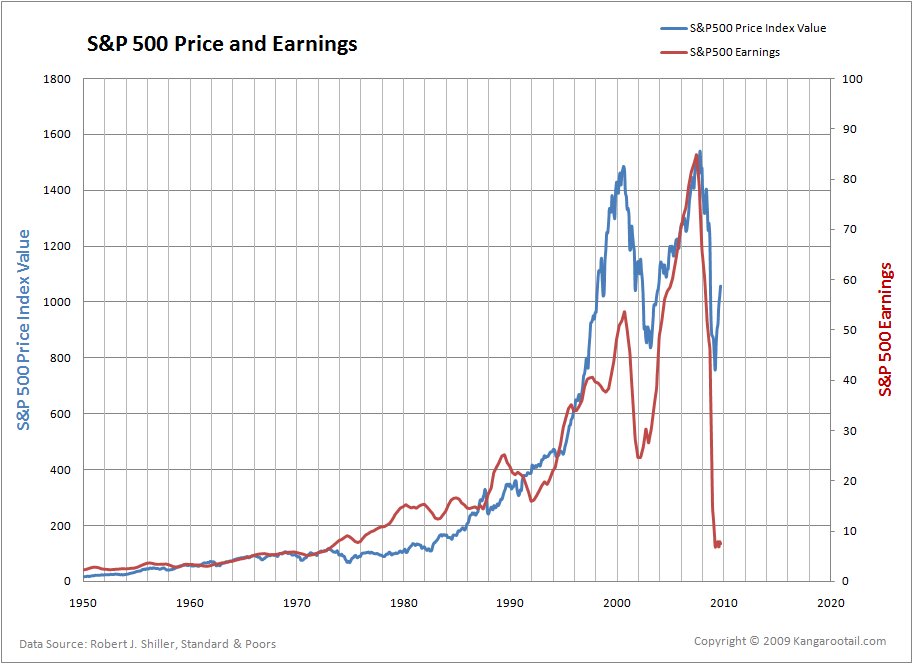
Meanwhile over in the blogosphere, Zero Hedge has been doing some excellent investigative reporting on the near criminal enterprise that Goldman Sachs has become, not just robbing the small investor with their HFT computer system, but mutual fund managers as well. Rob Kirby at Financial Sense has been reporting on the downright bizarre happenings in the precious metals and Treasury Bill markets, and then there's this; Dr. Carsten Mundt of Kangaroo Tail charts the S&P 500. In a normal market, the P/E Ratio should top out at about 20.

sp500-pe-ratio-10-6-09

Compare the solid prosperity of the 1950's with where we are today. Compare the Reagan boom years of the 1980's, the so-called "Decade of Greed", with where we are today. Does it look like everything is going to be fine, or would you say that something has gone terribly wrong? This booming market has nothing to do with company profits. In the next chart, the red line shows the earnings of the 500 companies.

sp500-price-and-earnings-10-6-09

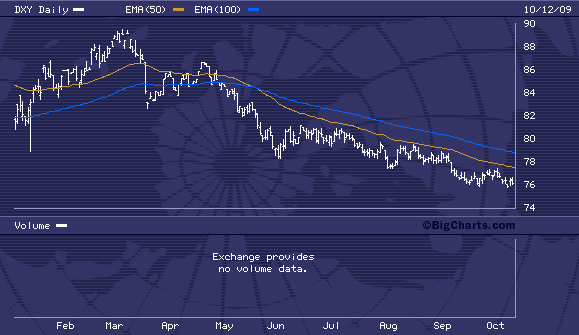
As a final point, in case you might think these things don't affect you, here's what the value of the money in your wallet has been doing since the beginning of the year. Note that the fall in the dollar started in March, the same month that the "recovery" supposedly began.

dxy ytd

It wasn't so long ago that the traditional media was full of stories about bankrupt newspapers and plunging TV ratings. It's a subject they'll no doubt be returning to in the future.

Wednesday, July 22, 2009

The Coming Devaluation

It looks like the stars are coming into alignment for a devaluation of the dollar. The first set of signs comes from then recent run-up in stock prices, and subsequent multi-billion dollar bonuses, involving the Wall Street banks. An excellent look at this is by Daniel Harrison, who points out that some of the bigger banks resorted to accounting tricks to post a good quarter.
But on closer inspection, these profits reveal little more than the return of risk appetite in the face of rising problems at the operating-level. For instance, in the case of JPMorgan, investment banking revenue helped offset rising defaults on consumer loans, while Citi masked its operating losses with a one-time asset sale.
They are not likely to post another good quarter which will add fire to another round of stimulus.

On top of that, both gold and the Euro are poised for an upturn. There is a great video that shows the analysis for a gold price increase. It also doubles as a good primer on how to analize a chart, if you've ever wondered how they do that. It runs about 7 minutes. There is also good video on the rising Euro versus the dollar. Currencies are more complicated than commodities, but it's the same idea.

The only good sign I can see on the horizon at this point, is the typical end of summer fall in gas prices. From a consumers point of view, we'll still be able to get around, we just may not be able to afford anything when we get where we're going. Whether it's inflating prices, or a deflating buying power of the dollar, the end result at the consumer level is the same. It's looking like it's about to get worse.

Monday, March 2, 2009

End the Fed

Thanks to Vox Day for pointing this out. It's too good not to pass along.

The Federal Reserve’s low interest rate policy is a big mistake; it is not a panacea.

Artificially low interest rates are achieved by inflating the money supply. Low interest rates penalize the thrifty and those who save are cheated. It promotes consumption and borrowing over savings and investing. Manipulating interest rates is an immoral act. It’s economically destructive.

The policy of artificially low interest rates caused our problems and therefore cannot be the solution. The market rate of interest is crucial information for the smooth operation of the economy. A central bank setting interest rates is price fixing and is a form of central economic planning. Price fixing is a tool of socialists and destroys production. Central bankers, politicians, and bureaucrats can’t know what the proper rate should be. They lack the knowledge and are deceived by their own aggrandizement.

Manipulating the money supply and interest rates rejects all the principles of the free market. Ironically free markets and sound money generates low rates, but unlike the artificially low rates orchestrated by the Fed, the information conveyed is beneficial to investors and savers. The Congress, by conceding this authority, conveys extraordinary economic power to the elite few. This is a power that has been abused throughout history. Only the Federal Reserve can inflate the currency, creating new money and credit out of thin air, in secrecy, without oversight or supervision. Inflation facilitates deficits, needless wars and excessive welfare spending.

Debasing a currency is counterfeiting. It steals value from every dollar earned or saved. It robs the people and makes them poorer. It is the enemy of the working man. Inflation is the most vicious and regressive of all forms of taxation. It transfers wealth from the middle-class to the privileged rich. The economic chaos that results from a policy of central bank inflation inevitably leads to political instability and violence. It’s an ancient tool of all authoritarians. Inflating is never a benefit to freedom loving people. It destroys prosperity and feeds the fires of war. It is responsible for recessions and depressions. It’s deceptive, addictive and causes delusions of grandeur with regards to wealth and knowledge. Wealth cannot be achieved by creating money by fiat. It instead destroys wealth and it rewards the special interests.

Depending on monetary fraud for national prosperity or a reversal of our downward spiral is riskier than depending on the lottery.

Inflation has been used to pay for all wars and empires. And they all end badly. Inflationism and corporatism engenders protectionism and trade wars. It prompts scapegoating: blaming foreigners, illegal immigrants, ethnic minorities, and too often freedom itself for the predictable events and suffering that result. Besides, the whole process is unconstitutional. There is no legal authority to operate such a monetary system. So let’s stop it. Let’s restore a policy of prosperity, peace, and liberty.

The time has come. Let’s End the Fed.


Congressman Ron Paul's speech to Congress 2/25/09

Housing and Recessions

I ran across a article at Calculated Risk that has 20 good charts; so many that I had trouble picking just one. This chart shows the relationship between housing construction and recessions, and brings up 2 important points.


The first point is that housing spikes and recessions are not necessarily related. There are several smaller spikes in home construction outside the recession areas.

The second point is when recessions contain housing spikes, one sure fire way to end a recession is to stop building so many unsellable houses.

I recently started following Guy Johnson on Twitter. He blogs at Reno Realty. The last post there discusses a house in the "bungalow district" on the "wrong side" of Wells Avenue. It's selling for $89,000. Out of curiosity, I drove over. It's definitely a fixer-upper. It has aluminum siding on the street side and, well, something else on the other 3/4's. Several large tree stumps decorate what used to be a backyard lawn. Still, I came away with a vague feeling of optimism. It was a real house, on a real foundation, and I could afford it if I wanted it. That's assuming I could find a banker foolish enough to loan me tens of thousands of dollars.

With our government insisting on creating jobs and stemming unemployment, it means we will still be building more unsellable houses and prices will continue to fall. And, thanks to our government, there are plenty of foolish bankers still in business. Who knows, in another 6 months, I might be able to afford a decent house in a decent neighborhood.

So keep the bailouts coming Mr. President; keep that monopoly money flowing and the bubble expanding. I'm almost there. Too bad for everyone else though.

Tuesday, February 17, 2009

Deconstructing the Lost Decade

There has been much talk of Japan's "Lost Decade" recently. In the IBD this morning, Robert Samualson lays out a few pertinent facts.

First and foremost is that, historically, government stimulus has a mixed record. Sometimes it works and sometimes it doesn't, and nobody knows why. Each situation is different enough that there is no conventional wisdom that applies to all.

Today, on one side of the argument, President Obama warns of a Japanese style stagnation; on the other, conservatives argue that the Japanese government instituted eight stimulus packages, none of which accomplished anything. They are both right and wrong at the same time. The Japanese experience has little to do with what we are going through now for the simple reason that we are not Japanese.

Japan has what Richard Katz, editor of the Oriental Economist, terms a "dual economy." On the one hand, export industries (autos, steel, electronics) are highly efficient. They face intense global competition. On the other, many domestic industries (food processing, construction, retailing) are inefficient and sheltered from local competition by regulations or custom.

Since the early '80s, U.S. economic growth has depended on a steady rise in consumer spending supported by more debt and increasing asset prices (stocks, homes). Just as the mid-'80s signaled the end of Japan's export-led growth, our slump signals the end of upbeat consumption-led growth.


The problem in both cases is, once the formula has played itself out, where to find new areas of growth. Our government has been driving out manufacturing, or inviting them to leave, for decades. Americans really don't make much anymore. Now that consumers are staying home, we don't buy much anymore either. If we don't make anything or buy anything, then what are we doing?

This problem is bigger than any stimulus can solve. If we bring back the factories, we'll bring back the jobs, and bring back the growth. Anything less is wasted effort.

Friday, January 23, 2009

What Dollar Devaluation Looks Like

This morning brings another eye-popping chart from Shadow Stats.


This chart is designed to track M3 (total wealth), since the government stopped in 2006. This time it's the M1 money supply (circulating currency) that concerns me the most. When the government sets the prime rate at 0%, literally giving money away, this is the inevitable result. The gap between circulating currency and wealth is the amount of devaluation.

The dollar is best defined as a storehouse of wealth. When it is given away for free, then what is it really worth? Our soon to be Treasury Secretary is likely to follow the pattern. Since he "forgot" to pay his taxes (cue laugh track), and having blown a perfect opportunity to head off the bank crisis as Chairman of the New York Reserve Bank, there is little hope that he will change anything. By re-inflating the false-wealth bubble, the government is proving Lincoln's adage that some of the people can be fooled all of the time.

And before I'm done; A hearty thanks to Senator Ensign, from those of us about to lose what little wealth we have left, for rolling over and playing dead in the Senate confirmation hearings yesterday; way to go along to get along. It's enough to make me wonder if the good Senator has a hoard of silver ingots stashed under the floorboards of his mansion.

Wednesday, January 7, 2009

Finally Some Good News

I've been meaning to write about a book I read over the summer called Ahead of the Curve by Joseph H Ellis. It's by far the best book on the economy and the business cycle that I've ever read. Mr. Ellis was a retail analyst at Goldman Sachs for 30 years. In his book, he uses charts that measure different parts of the economy that go back to 1960. They track year-over-year percentage differences. Everything is measured the same way over the same time period, and measured against each other, so you can see how one part of the economy affects the other.

The book was written in 2004, but the really nice thing about that is the charts are constantly updated here. According to Mr. Ellis, the first sign of a recovery after a recession is an upturn in real wages, followed by consumer spending. Real wages are defined as the buying power of the dollar. With falling commodity prices it makes sense that real wages would be rising. Rising unemployment is a trailing indicator and therefor meaningless as an indication of recovery. The real wages versus consumer spending chart is here. Notice the green line at the extreme right of the chart.

We're still at least 2 months away to know if this really means anything. Real wages need to keep rising in order for consumer spending to turn. But, it's the first good sign I've seen in a very long time.

Friday, December 12, 2008

Household Debt

I thought I might have some good news to report.

As of Sept. 30, the total outstanding debt for households shrank at an annualized rate of 0.8% from $13.94 trillion to $13.91 trillion, the Fed said in its quarterly flow of funds report. It's the first decline in household debt ever recorded in the report.


Upon further revue, the real reason for the fall:

Mortgage debt fell at a 2.4% annual rate to $10.54 trillion, as foreclosures mounted and fewer new mortgages were taken on.


It's difficult to increase household debt when you don't have a household. Meanwhile, credit card use continues unabated.

Other consumer debts, such as credit cards and auto loans, increased at a 1.2% annual rate in the quarter to $2.6 trillion.


Running up the credit card now might not be such a bad idea. With all the government borrowing, the value of the dollar will certainly fall in the future. It's a kind of 'spend it while you have it' mentality. As for me, I got rid of my last credit card years ago and am unlikely to get another one anytime soon.

Monday, November 24, 2008

M3 Update


Little wonder why the government stopped tracking M3. It's the total value of our country, expressed in dollar terms. M1 shooting up at the bottom, is the Treasury flooding the market with cash.

Somewhat related, I've been having trouble getting a table to load on this page all weekend. I posted it on AAB for those interested.

Thursday, November 20, 2008

Quote of a Lifetime

Rob Kirby unearths a gem from the recent past;

…as told by [then] Federal Reserve Vice-Chairman, Alan Blinder on national television, “The last duty of a central banker is to tell the public the truth.”

I suppose that’s true of anyone in Washington.

I was looking forward to following the $750 billion bank bailout story. I subscribe to, and get a daily boatload of data from, the National Bureau of Economic Research (NBER). I receive daily emails directly from the Treasury Dept. I have several on-line sources for economic news. And yet, my original questions remain; how much have we spent? Is some of the money in the form of loans? What have we bought? How much did it cost? Are we making any money yet? Are they short-term or long-term investments?

Secretary Paulson promised transparency in testimony before congress. It looks pretty dark in there. So far, there’s nothing to follow. At what point do our representatives turn on their flashlights and take a look around?

The Real Cost of Bailouts

Now that the Republicans have started the gravy train chugging down the tracks, we can expect the Democrats to hop on board. It's important to remember the original problem. There is no shortage of cash. In fact, the better argument is that there is too much cash: credit is already too easy.Jonah Goldberg nails the the original problem, uncertainty:
One of the main reasons there’s all of this “money on the sidelines” out there among private investors is that Wall Street doesn’t know what the government will do next. Will it bail out the auto industry? The insurance companies? Which taxes will go up? How far will interest rates go down? How long will the federal government own stakes in the banks? Will more stimulus checks go out? If so, how big will the deficit get?

Uncertainty is what causes banks not to loan to each other. Uncertainty causes private investors to pull their money out of Wall Street. Uncertainty causes business owners not to take risks in new equipment or new workers.

Don Boudreaux, Chairman of the Department of Economics at George Mason University, explains the real cost of bailouts:
The number of different places from which these resources will be taken is large and spans a continent. So it's easy to overlook the fact that each of many productive firms from across the country will, as a result of this bailout, pay more for steel, machine tools, fuel, and other inputs they use in production. These other firms will contract their operations; they'll employ fewer workers; they'll produce less output.
On Cafe Hayek, Professor Bourdreaux points out the private investment during the Great Depression:


As government spending expands, private investment contracts. When government becomes active, the private sector stops. We'll hit bottom only when the government stops. That looks to be a long time from now.

Saturday, October 25, 2008

Mr. Main Street

There's an excellent article in today's Wall Street Journal about Fred Smith, CEO of Fed-Ex. It brings up an important point regarding tax policy and the flow of capital. Something we all need to think about as different solutions to the financial mess are bandied about:

...national policies that favor what he calls "the financial sector over the industrial sector."

"Rather than in our business where you have to have a dollar of equity for, 10 cents or 15 cents of debt," he explains, "it's exactly the opposite in the financial sector where you have one dollar of equity for 10, 25, 50 times risk."

"Not too many young people coming out of school are studying to be production managers at General Motors." He says that most of FedEx's first line managers come not from the top flight universities, but out of community colleges and the military.

He has come to hold the get-rich-quick Wall Street financiers in more than a little disdain. He views the heroes of the U.S. economy as the companies that actually produce real goods and services. He sees the Wall Street collapse as an inevitable byproduct of investment bankers building multitrillion dollar debt pyramid structures.

So how do we fix this problem and retool our industrial sector in a pro-competitive fashion? "We've got to reduce the taxes on equity. Let companies expense their capital purchases."


This is how the "tax the rich, spread the wealth" mentality serves to hurt producers and enrich companies that don't add value to the economy. At a bank, the liabilities are the assets. Although the bank itself adds value by holding the debt, there is little to tax under the current system. Meanwhile, companies that actually make things have to claim revenue in order to buy capital equipment. They are then taxed at 38% on their revenue.

Fed-Ex employs 290,000 people, mostly blue collar, community college graduates and former military. Who do bankers hire?

Wednesday, October 22, 2008

The Road to WW III?

Karl Denninger at The Market Ticker notes some strange happenings between Treasury and the 9 banks receiving bail-out money. It seems the $250 billion was never intended to help the credit squeeze. The banks will not be lending it to other banks. They'll be hoarding it to improve their own bottom lines. So, what was the point of it all, besides letting Paulson's friends keep their jobs?

F. William Engdahl at 321 Gold adds some interesting history to our current situation. In 1931, the Bank of England, together with JP Morgan (the bank) combined in a hostile take-over bid of the German commercial banks. The result was that the German banks collapsed, leading to a severe recession and high inflation. The German government at the time had to cut social programs and raise taxes, leading to the unfortunate rise of Adolph Hitler.

Fast forward now, to our own time. After Treasury's $750 billion grab was OK'd by congress, Paulson was set to play the game by the standard set of rules. On Oct. 8th the British government abruptly nationalized 8 banks, including the Bank of Scotland. This move may have been as much about thwarting Scottish independence as saving the British banking system. Two days later, the Germans announced they would follow England's lead.

Since the whole credit mess started in the US, that left $68 trillion in debt sitting on the American table. Paulson, forced to play defense, had no choice but to socialize the 9 largest US banks. Not doing so would have left them sitting ducks for a European take-over.

It's an interesting theory, and the facts and timing seem to fit. Two things we can say with certainty: (1) there is a very high stakes game being played that has little, if anything, to do with Main Street, (2) the government story, echoed in the press, is not the real story.

Thursday, October 16, 2008

Sub-Prime Explained

If you don't mind some obscenities, this explains the sub-prime situation pretty well.

The Wells Fargo Non-Plan

I'm on vacation this week, and hanging out with mom for a few days before heading off for the races this weekend. We were watching CNBC yesterday and a guy from Wells Fargo was being interviewed. They asked him what they were going to do with the $50 billion in taxpayer money that they're getting.

He said he didn't know because they really don't need it. Even after buying Wachovia for billions, their balance sheet was still in good shape.

Who's doing their homework over at the Treasury Dept.? Anybody?

I wonder if the stocks have already been bought? If so, we're getting a pretty good haircut today.